
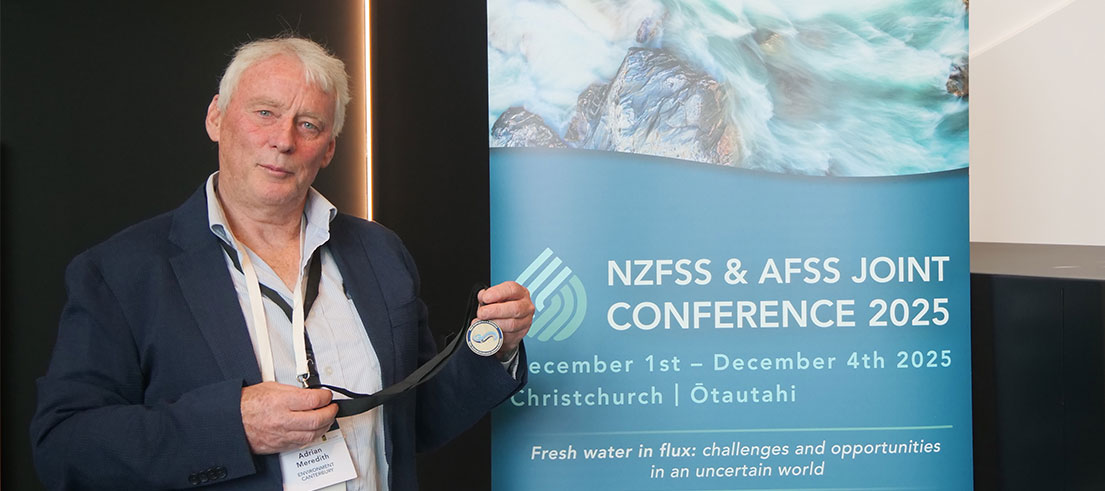
Canterbury scientist makes history with national medal
One of our most respected scientists has received national recognition for decades of dedication to Aotearoa New Zealand’s freshwater ecosystems.
Dr Adrian Meredith, principal scientist for water ecology, received the New Zealand Freshwater Sciences Society Medal, marking the first time a regional council scientist has achieved this honour. The medal is typically awarded to research and university academics.
The medal recognises Dr Meredith’s outstanding contribution to freshwater science, from advancing ecological understanding to shaping policies that protect rivers, lakes, and wetlands across the country. His work has been instrumental in ensuring healthier waterways for generations to come.
“This award is a testament to Adrian’s unwavering commitment to science and the environment,” said Elaine Moriarty, manager of water and land science. “His leadership and expertise have set a benchmark for excellence in freshwater ecology.”
The award was presented at the annual New Zealand Freshwater Sciences Society/Australian Freshwater Science Society conference, where Adrian gave a keynote speech providing insights to his career, highlighting what drives his passion for science and how working at the Council allows him to put that passion into action.
“It means I can do my bit, using science to guide decisions and make recommendations to governance that lead to better outcomes for Waitaha Canterbury,” he said.
A career dedicated to freshwater
Adrian has worked for us for nearly 30 years, from the Chatham Islands to the Canterbury high country. His approach is guided by kaitiakitanga (stewardship for the environment) and a simple question:
“Why are we measuring this, and what does it mean for the environment?”
Through his role, Adrian focuses on three key areas: planning, monitoring, and regulation. These skills enable him to provide clear, science-based advice to councillors and decision-makers, ensuring they have the information they need to make choices that benefit the environment and the people of Waitaha Canterbury.
Innovation that changed the game
One of Adrian’s boldest ideas came in the early 2000s, when monitoring Waitaha Canterbury’s high-country lakes proved difficult.
“People cherish these lakes, places like Te Puna-a-Taka Lake Clearwater, and assume they’re pristine because they look picture-perfect on calendars,” Adrian said. “But deep down they were deteriorating rapidly.”
His solution? Use helicopters to collect data – a radical idea at the time that allowed monitoring of 30 lakes in a single day, providing a health snapshot across the region. Two decades later, helicopter monitoring remains a vital tool.
Guardians of the environment
Adrian often jokes that he and his colleagues are a bit like the characters from Guardians of the Galaxy, except instead of protecting the universe, they’re “guardians of the environment and guardians of science.”
He believes science underpins effective monitoring and planning, which form the foundations of good environmental management.
“What keeps me motivated is the belief that the environment is the foundation of everything,” Adrian said. “Success isn’t just about outcomes; it’s about staying true to your values to achieve positive outcomes.”
“That’s why I suspect I got this medal,” Adrian said. “I’ve consistently worked to that belief throughout my career.”
Despite an illustrious scientific career, Adrian said he still has “unfinished business” in his field and remains committed to giving honest advice, supporting innovation, and being the conscience of the organisation.
The recognition highlights the vital role regional councils play in safeguarding New Zealand’s natural resources and celebrates a career dedicated to making a difference.
Make a difference: Learn how you can protect our waterways from your own home.