
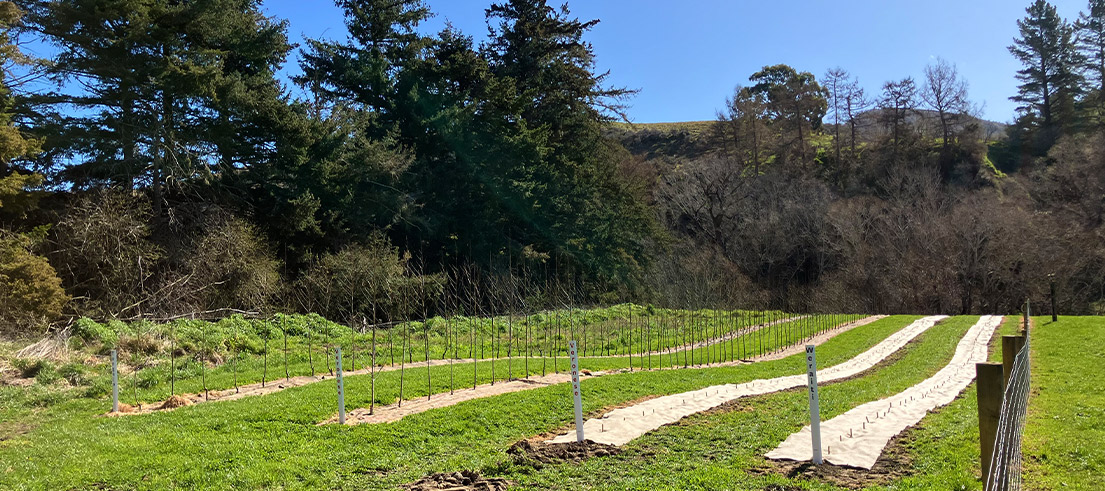
30,000 trees planted on 229 farms: SCAR takes root across North Canterbury
More than 30,000 trees planted, 1100 hectares of erosion-prone land with high native biodiversity values retired, and strong relationships built across 229 farms — that’s the positive impact the Soil Conservation and Revegetation (SCAR) programme has delivered so far.
The programme, launched in 2019, is jointly funded by Canterbury Regional Council (Environment Canterbury), the Ministry for Primary Industries (MPI), and landowners.
What is SCAR?
SCAR provides farmers with funding and on-farm support to install poplar poles on erosion-prone land.
These start as three-metre-long dormant poles that are planted into highly erodible hill country during winter, while they are still dormant.
As they come out of dormancy, they begin to develop roots and leaf out above their protective sleeve, and within four to six years, they provide effective soil erosion protection to safeguard productive land.
SCAR supports the establishment of on-farm satellite poplar pole nurseries and also helps fund sheep and deer fencing to exclude stock. The fencing enables the retirement of unproductive, erosion-prone land, which allows for native reversion and planting.
The programme also funds the development of Land Use Capability (LUC) maps to inform farm environment planning and land‑use decisions.
Support that goes beyond planting
Working with catchment groups like the Hurunui District Landcare Group (HDLG) and adopting an integrated catchment approach has delivered further success in the programme, not only for soil conservation but also for enhancing biodiversity and improving water quality outcomes.
Across Waimakariri, Hurunui, Kaikōura and now Banks Peninsula, SCAR has become an incredibly successful programme for tackling hill country erosion, improving soil health, and supporting long-term farm and community resilience.
Council support for SCAR
At a full council meeting on Wednesday, 25 March, councillors approved a staff request to apply for up to $750,000 per year from the Ministry for Primary Industries’ Hill Country Erosion Programme to continue SCAR for the July 2027 to June 2031 period.
Environmental Regulation and Protection Core Service Lead Councillor Claire McKay said SCAR represents a smart, evidence-based investment in the long-term health of our region.
“Through strong partnerships with MPI, landowners and catchment groups, the programme is delivering measurable outcomes for soil conservation, water quality and biodiversity, while also strengthening the resilience of our farming communities,” she said.
SCAR by the numbers
Since it began in 2019 SCAR has achieved significant results, including:
- More than 30,000 poplar poles planted across 164 farms
- 1100.7 hectares of land retired to allow native reversion to successfully establish across 60 farms
- 229 farms engaged with by the programme team
- 15 on-farm nurseries established, producing an estimated 8380 poplar poles each year
- 100,269 hectares mapped through Land Use Capability plans
- $10 million in total investment leveraged through the programme
Practical benefits for farmers
For farmers, SCAR helps to maintain soil health and productive land, reduce erosion and sediment entering waterways, and deliver wider benefits for water quality, biodiversity and mahinga kai. Because of this, it strengthens on-farm resilience to the impacts of climate change.
North Canterbury water and land team leader Andrew Arps says a key factor in the programme’s success has been the strong relationships built between the SCAR team, farmers and wider catchment groups through widespread, face-to-face engagement and on-farm practical workshops.
“The team resonate and work well with farmers. As a result, farmers have got involved in the programme in large numbers,” he says.
Andrew says farmers clearly see the value of the programme and have appreciated learning how to use their land more effectively. This includes retiring highly erodible areas from production to allow indigenous biodiversity to thrive, and planting poplar poles on key pasture producing areas that need to stay in the farm system but are vulnerable to hill‑country erosion.
Need help reducing erosion? See how the SCAR programme can support your farm and reduce erosion.