
From the Opuha to the Kakahu - Managing water clarity
Canterbury Regional Council (Environment Canterbury) is actively working with Opuha Water Limited to address water clarity issues in the Kakahu River, while maintaining a reliable water supply for farming communities.
About the Opuha Dam and water supply
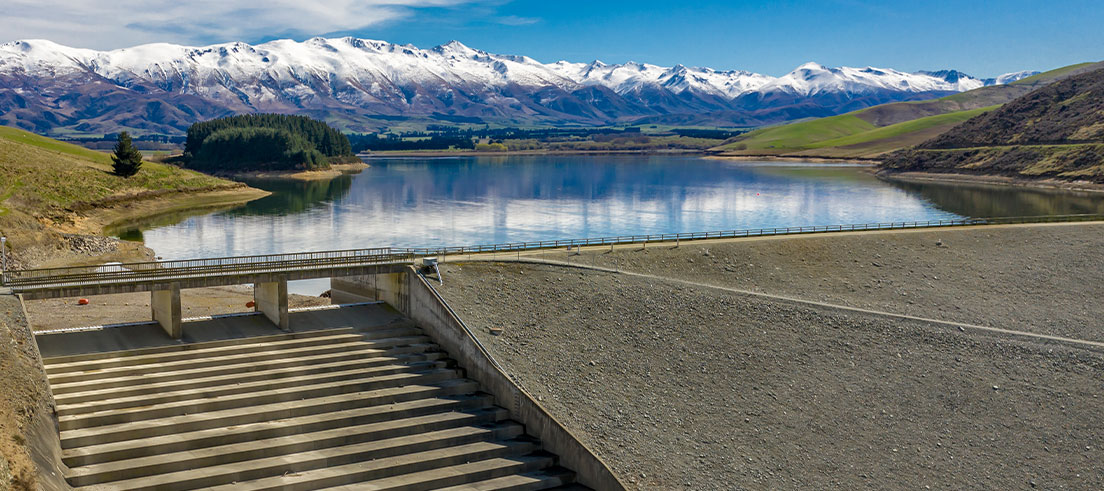
Location: The Opuha Dam sits 17 km north-east of Fairlie and consists of a 50-metre earth dam that stores over 74 million cubic metres of water. It is owned by Opuha Water Limited (OWL) and its shareholders.
Purpose: The lake provides water that maintains environmental flows in the downstream catchment and for irrigation, as well as urban and industrial supplies.
Water use: One of the water takes from the lake supplies water for irrigation to members of OWL via a water race, with any unused water being discharged into the Kakahu River via a pipeline. The clarity of the water source is affected by the size and nature of rainfall events in the catchment.
- After heavy rain, more sediment enters the lake
- If heavy rain occurs in the growing season, water entering the race may have higher levels of sediment
Discharge consent and water clarity limits for the Kakahu River
OWL holds a resource consent for this discharge. A key consent condition relates to water clarity and requires that the discharge must not reduce downstream water clarity in the Kakahu River by more than 50 per cent after reasonable mixing.
It’s important to note that clarity outcomes depend on both the Opuha and Kakahu river systems. In practice, this means that the irrigation schemes can materially influence clarity outcomes - positively or negatively.
Why reliable water supply matters
To ensure they comply with their consent conditions, OWL must stop discharging water if they cannot be sure the discharge will stay below the 50 per cent threshold.
For those that depend on that water for irrigation, this can have a dramatic effect on:
- animal wellbeing
- the viability of their farming operations
- the well-being of the wider community.
Historically, exceedances have been relatively rare and the adaptive management approach written into this consent allows for OWL to turn off the supply when it exceeds 50 per cent and turn it back on again once it falls below. However, unusual weather patterns during the 2025 growing season meant the scheme had to shut down more often than usual, with the consequence that farmers and communities lost access to water at a potentially critical time for crops and pasture.
Why hasn’t enforcement action been taken?
Until recently, the evidence for environmental effects that can be directly attributed to the scheme’s discharge hasn’t been robust enough to support enforcement action with a reasonable probability of success.
However, the quality of our data will improve once our own science team undertakes a study later this year.
With better knowledge, future decisions will be better informed and enforcement action becomes a more viable option, should it be necessary.
Is there a solution?
A workable solution would need to meet these two goals:
- Avoid any future exceedances of the water clarity limit
- Maintain a reliable supply of water for those that need it, regardless of weather conditions in the catchment.
In late March 2026, the OWL board and stakeholders met to discuss the viability of a pipeline. This option would:
- reduce the sediment loading of water taken from Lake Opuha
- prevent sediment from entering the water race.
What happens next?
As of late March 2026, OWL has not decided to progress the pipeline proposal as per the critical path agreed with Environment Canterbury.
We have been clear that, OWL must not discharge into the Kakahu River beyond the requirements of their consent.
We will continue to monitor the situation and intend to enforce compliance as appropriate, to achieve the best outcome for the environment, for the sustainability of the resource, and for the communities affected.
This page will be updated as decisions are made about how to manage this activity sustainably — whether through a pipeline or another solution.