
Current river works
Here you can find information on our current river maintenance works we are undertaking across the region through targeted rates from river rating districts.
This includes operational tasks such as:
- weed control
- tree maintenance or removal
- infrastructure inspections.
Monthly river works plan: We also provide a monthly work plan that provides an overview of upcoming and current river works operations by area and river. Download the work plan—Kaikōura to Waitaki February (PDF file, 571.71KB)
Annual work plans: Find out what flood protection and drainage scheme maintenance activities are planned in your rating district from July 2025 to June 2026. Download work plans: southern region (PDF file, 2.7MB), northern region (PDF file, 1.86MB), central region (PDF file, 3.7MB)
Need more information or help? Contact our customer advisory team via our online form or call 0800 324 636.
Note: Dates given are indicative, as weather may delay work completion.
Geotechnical investigations along the Ashley Rakahuri stopbanks
What: We’re carrying out ground investigations at 10 locations along the primary stopbank. This will involve drilling and digging test pits to help us better understand the stopbank and the ground beneath it and inform future flood protection improvements. This work is part of a wider project to strengthen flood resilience along the Ashley Rakahuri River. Find out more about the project and the options we’re exploring.
Where: Along the primary stopbank, from the Ōkūkū confluence to the estuary.
When: Work will begin on Wednesday 4 November.
What to expect: You may see drill rigs, excavators, and work crews in the area. Sections of walking and cycling tracks may be temporarily closed while work is underway. Please follow any on-site signage and stay clear of active work areas.
If access through private property is required, affected landowners will be contacted beforehand to discuss access arrangements.
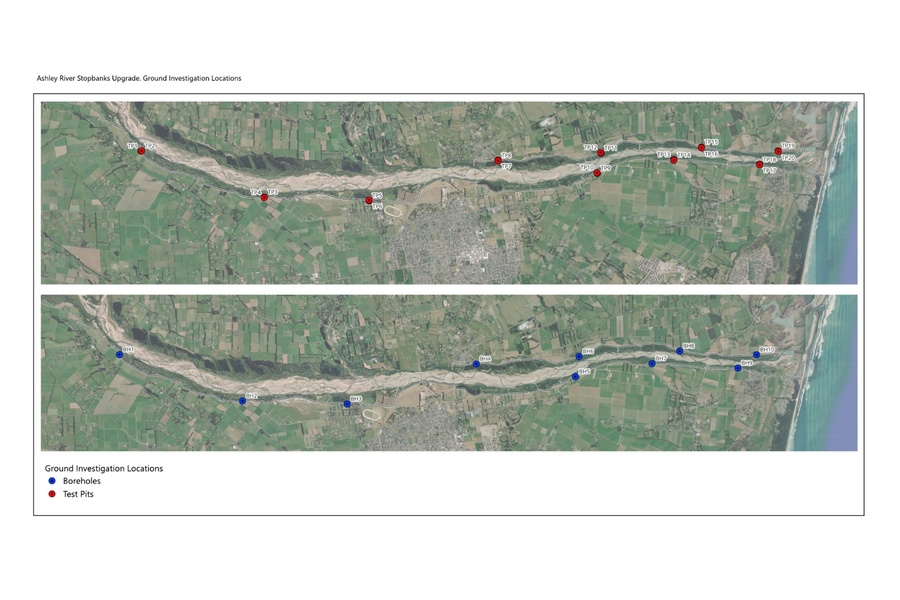
Areas of work along the Ashley Rakahuri Stopbanks
Tree clearance work at Waihi River, Waitui Drive, Geraldine
What: Tree clearance, mainly sycamore trees with some willow removal
Where: Waihi River beside Waitui Drive, Geraldine
When: November to December 2026
Starting November 2026 for approximately 3-4 weeks
We're removing mostly sycamore trees, along with some willow, from a section of the Waihi River beside Waitui Drive in Geraldine. This is the first stage of work to widen the river channel and improve the river's ability to carry flood flows through this area.
During the work, people can expect to see heavy machinery operating on site and an increase in truck movements along Waitui Drive as timber and other material is removed.
For safety, signs will be installed at river access points and access to parts of the river and work area may be temporarily restricted while work is underway.
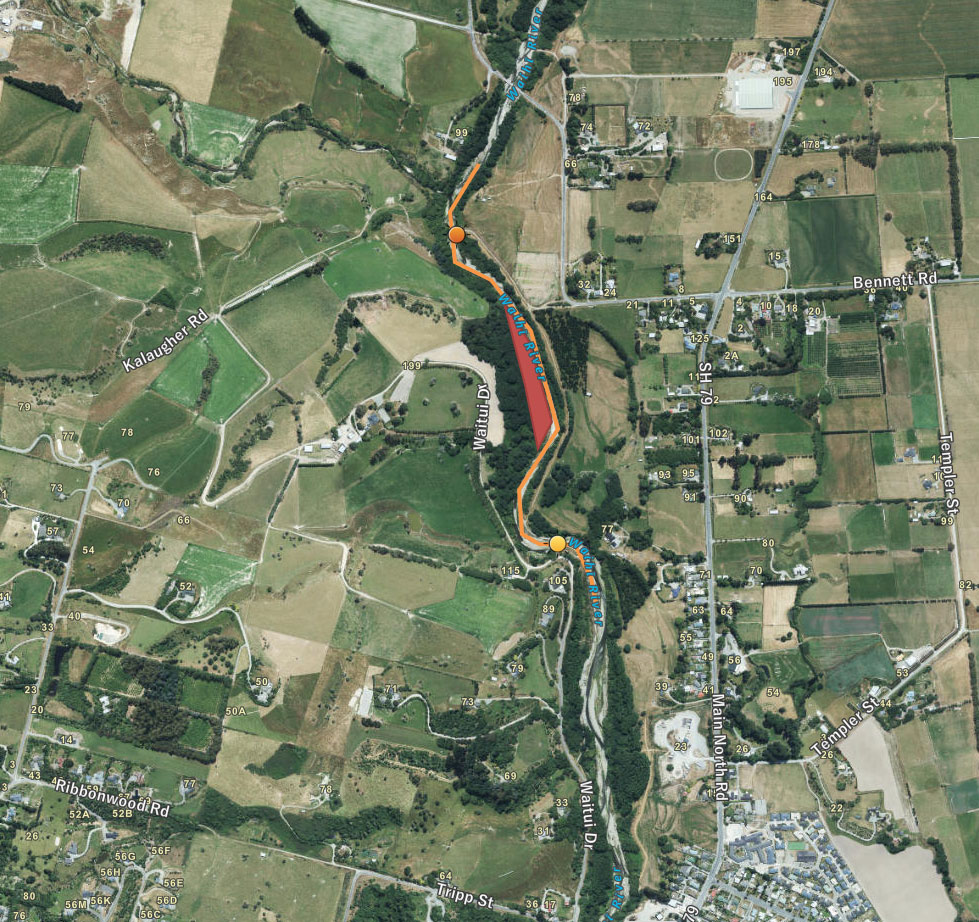
Area of work along the Waihi River near Waitui Drive, Geraldine
Regional targeted weed control works
What: Ground-based weed control spraying across Canterbury
When: September 2026 to March 2027
Where: Canterbury Rivers: fairways, access tracks, stopbanks and around the rivers and drains listed below.
Why: Our rivers are vulnerable to invasive weed infestations, and we need to manage harmful weeds for flood control and biodiversity protection. Left unchecked, invasive weeds contribute to significant flood risk by occupying the channel, which can obstruct natural water flow and redirect floodwaters onto riverbanks or stopbanks. This can cause erosion and put critical flood protection infrastructure at risk. Weed growth can also contribute to the loss of aquatic habitats, nesting areas for native birds and reduce native plant populations.
Qualified Environment Canterbury staff and contractors carry out weed control measures in the open riverbeds within our drainage channels and on our berms and stopbanks, to help protect our communities from flooding and enhance biodiversity values.
Northern
- Kaikoura Rivers (Kowhai, Lukes Creek, Middle Creek, Harnetts Creek, Floodgate Creek, Waimangarara, Lyell Creek)
- Kaikoura Drains
- Waiau Uwha River
- Chatterton / Rodgerson River
- Hurunui River
- Ashley river
- Kowhai leithfield
- Kowhai North
Waimakariri-Eyre-Cust
- Waimakariri River
- Eyre River
- Cust River
- Cam River
- Kaiapoi River
Central
- Ashburton Hinds Drainage Scheme
- Halswell River and Drainage Scheme
Hakatere Ashburton River and Tributaries
- Ashburton River (Incl, Main Stem, North Branch, South Branch)
- Taylors Stream
- Bowyers Stream
- Pudding Hill Stream
- Hinds River, incl North and South Branch
- Halswell River
- Rakaia River
Waikirikri / Selwyn River Tributaries
- Selwyn River
- Hororata River
- Hawkins River
- Waianiwaniwa River
Wairewa / Little River Tributaries
- Okana River
- Okuti River
- Opuahou Stream
- Hukahuka Turoa Stream
South
- Hook Drain
- Waihao River
- Waitaki River
- Upper Waitaki Rivers (Takapo, Pukaki, Ohau)
- Taumatakahu
- Te Aitarakihi
- Seadown Drains
- Clandeboye Drains
- Rangitata River
- Orari River
- Waihi River
- Temuka River
- Opihi River
- Tengawai River
- Opuha rivers
- Pareora River
- Makikihi River
- Otaio River
What chemicals do we use for targeted weed control?
Environment Canterbury uses glyphosate (a general broadleaf weed killer), triclopyr (brush weed killer), and surfactants under strict controls to control weed growth in riverbeds and berms under the terms of our resource consents CRC222040, CRC222041 and CRC222043.
Glyphosate is widely used in New Zealand and other countries as a general-purpose herbicide, it is regulated in New Zealand by the NZ Environmental Protection Authority (EPA) and there are laws around its use. Products containing glyphosate are considered safe when the safety instructions on the product labels are followed.
For more information about why and how we control weeds in rivers.
Rakaia River erosion repair works
What: With recent fluctuating flows the Rakaia river braid network has shifted in the lower reaches and has caused significant erosion to quickly occur on Rakaia Island. To help reduce the rate of land erosion which is currently occurring immediate action is required. A bulldozer will be working to open up a new braid to take pressure of the erosion site. This work will happen over the next few days. Works will be done in accordance with our environmental code of practice and include a bird survey of the islands before works commencing.
Further works to re-instate erosion protection infrastructure is required and Environment Canterbury is currently scoping these works alongside the initial response. Further works will need to take place very soon to stop the site getting larger during the fluctuating flows expected over the coming months.
Where: Rakaia River 1km upstream of the river mouth on Rakaia Island
When: Starting mid- September 2026
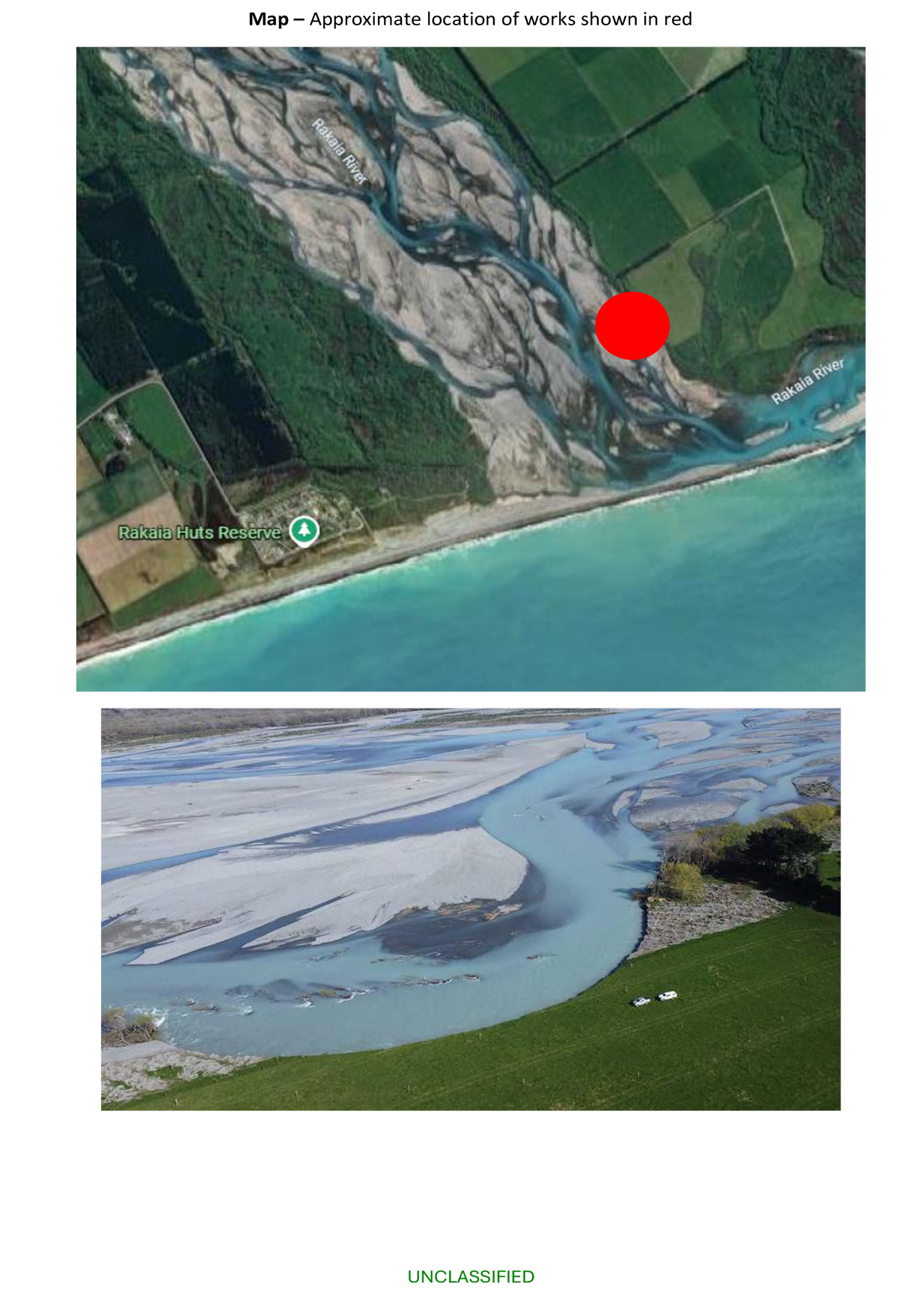
Work area on Rakaia Island, 1 km upstream from the Rakaia River mouth
Ashburton River Berm - Native asset maintenance and wider berm targeted weed control above Lake Hood
What: Maintenance will be carried out in three native planting areas within the berm, along with targeted weed control across approximately 6.6 ha. Weed control will focus on reducing invasive and exotic vines around the planted areas and supporting existing flood protection vegetation. A bike and walking track runs alongside the site. Signage will be placed to advise members of the public when spraying and weed control operations are taking place.
This work will be carried out over a minimum of three rounds. The first round will take place this month, the second at the start of summer, and the third at the end of summer. If required, a fourth round will take place in autumn. Maintenance and weed control activities are weather dependent. Crews will work on dry, non-windy days. Wider weed control will take place during late spring and summer. Members of the public can expect to see work crews operating within the berm at various times over the coming months.
Where: True right berm of Hakatere River, above Lake Hood, along the public walking and bike track.
When: September 2026 to June 2027
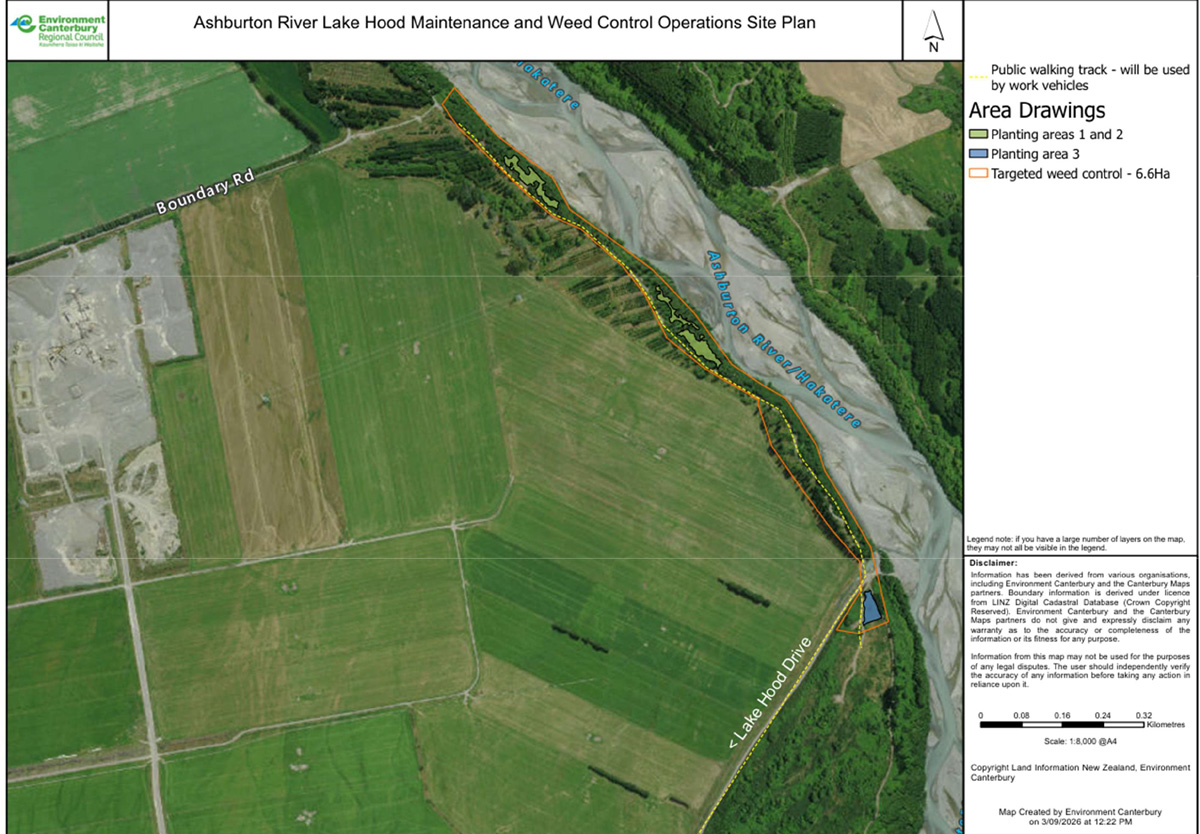
Work areas along the Ashburton River/Hakatere
Otukaikino Creek Confluence - Targeted willow control
Spring 2026
What: We will carry out targeted spraying and manual control of regrowing willow.
Where: Ōtūkaikino Creek confluence, near the walking and cycling track in Waimakariri Regional Park.
When: Late September to end of October 2026, weather permitting.
What to expect: You may see work crews and temporary signage in the area while work is underway. Please follow any on-site instructions.
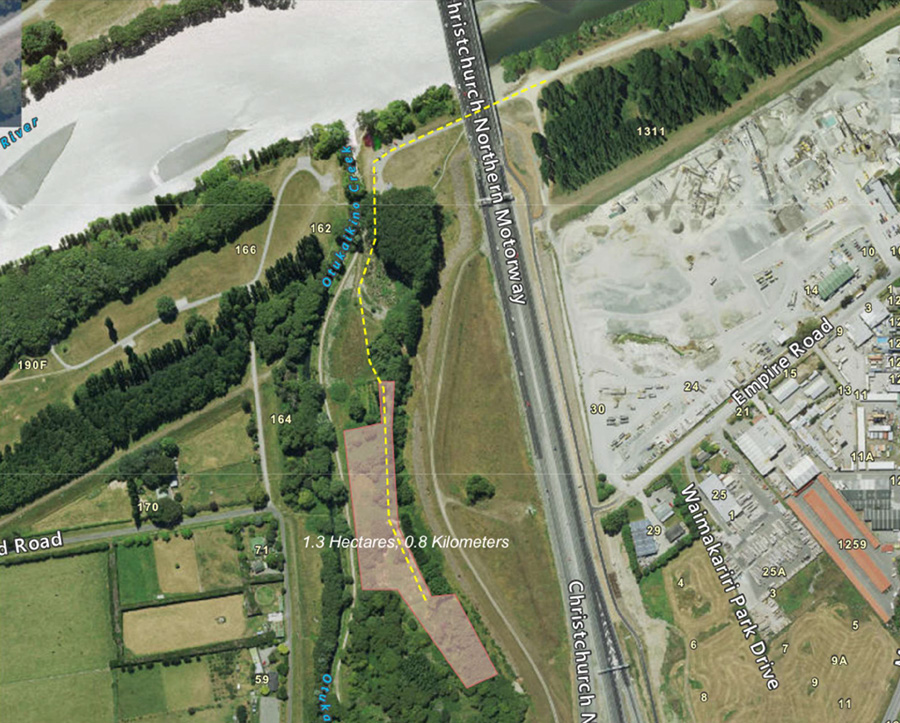
Targeted willow control area along Ōtūkaikino Creek
Hakatere / Ashburton River mouth
WHAT: Environment Canterbury is carrying out works at the mouth of the Hakatere / Ashburton River to create a low scallop through the beach. This will help realign river flows and provide a flow path if river levels rise.
We do not plan to physically divert the river away from its current mouth at this stage.
WHERE: Hakatere / Ashburton River mouth.
WHY: The river mouth has migrated significantly north. At its current location, river flows can increase erosion of nearby cliffs, creating a risk to adjacent properties and the Hakatere hut communities. These works aim to reduce that risk and help manage expected increases in river flow.
WHEN: Starting 27 August and expected to be finished by 30 August.
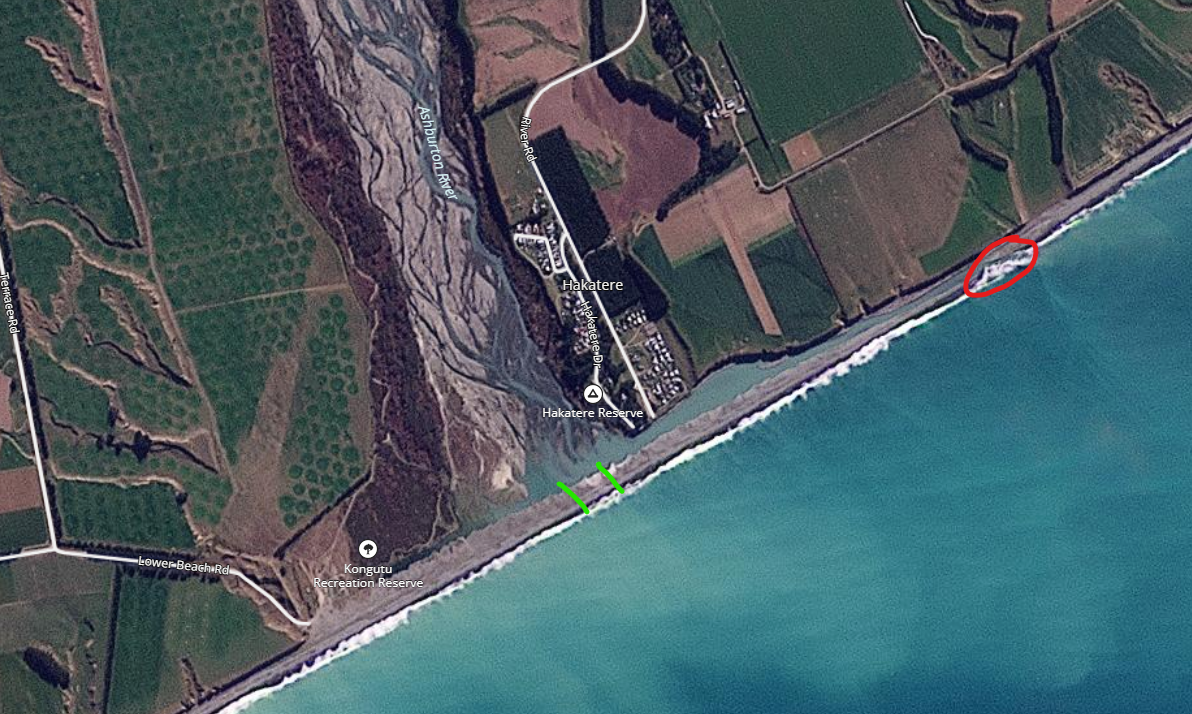
Hakatere / Ashburton River mouth works
Native planting and stopbank maintenance along the Ōpihi River in Fairlie
Starting in July 2026
In late July and August, we will plant around 1210 native plants at two sites along the Ōpihi River in Fairlie. A total of 1,000 plants will be planted between Talbot Road and Ōpihi Gorge Road, building on planting work that has taken place there in recent years. A further 210 plants will be planted near the SH79 Ōpihi River Allandale Bridge to replace some plants that need to be removed from the nearby stopbank as part of planned maintenance work.
Some of the plants being removed were planted by community volunteers. While these plantings were well-intentioned and provide environmental benefits, trees and larger shrubs are not suitable on stopbanks because they can weaken the structure over time and reduce its ability to protect nearby homes, farms and infrastructure during flood events.
Planting 210 native plants nearby will help maintain the area's ecological and amenity values while ensuring the stopbank can continue to provide flood protection for the community.
Before planting begins, an excavator will be used to prepare the site near the SH79 bridge.
Access to the work area may be limited while work is underway for health and safety reasons. Any restrictions will be clearly signposted.
- WHAT: Site preparation and native planting.
- WHERE: Ōpihi River, on the true left berm immediately upstream of the SH79 Ōpihi River Allandale Bridge and the true right berm between Talbot Road and Ōpihi Gorge Road.
- WHEN: Site preparation and native planting in late July and August 2026.
- Stopbank maintenance work planned for October.
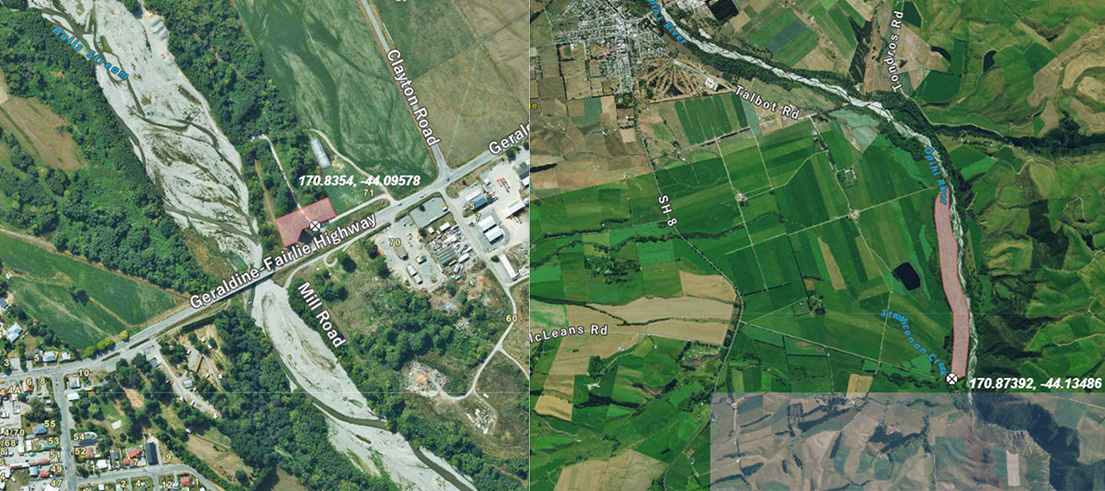
Figure 1: Approximate works area highlighted in red, 210 native plants will be planted at this site. Figure 2: A further 1,000 native plants will be spread in blocks throughout the area highlighted above, adding to previous planting efforts in this area.
Temuka River berm vegetation mulching and tree clearance – Winter 2026
WHAT:
Environment Canterbury will be carrying out vegetation mulching and tree clearance in several areas along the true left berm of the Temuka River.
The work is designed to improve the river’s ability to safely manage flood flows and increase the resilience of the berm during high river events.
Some areas will also be cleared in preparation for planting several thousand native and flood-protection plants.
These plantings will increase vegetation cover and diversity, helping to strengthen the berm over time.
WHEN: 20 July to early-November 2026
WHERE: Temuka River berm, near Temuka Domain and Temuka Golf Course
Temporary signage will be installed before work begins, and some areas will be closed to the public while work is underway. We ask people to follow all signage and stay clear of active work sites for their safety.
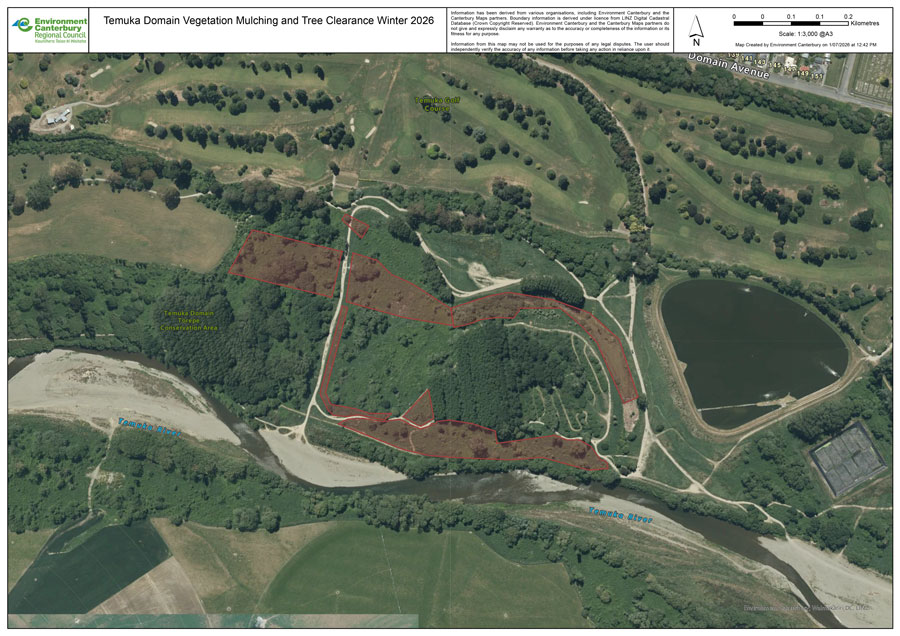
Map showing the vegetation mulching and tree clearance work areas at Temuka Domain for winter 2026.
Channel maintenance and native planting on Twenty One Drain
WHAT: We will be undertaking drainage channel maintenance and site preparation works within a coastal drainage channel between the Ashburton and Rangitata rivers.
The works involve clearing and processing woody material, improving access and preparing the site for riparian native planting.
Native planting will take place later this winter in August to increase indigenous vegetation cover and long-term shading and habitat values.
WHEN: July - August 2026
WHERE: Twenty One Drain, downstream of Ocean View Road
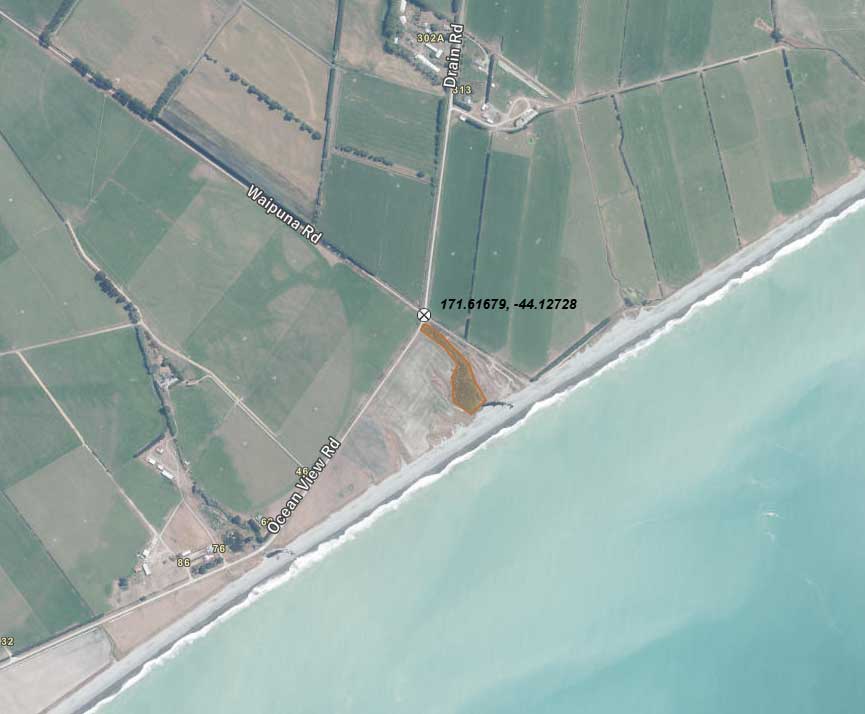
Channel maintenance and native planting area on Twenty One Drain
Takapō River tree removal
WHAT: Contractors for Environment Canterbury and Mackenzie District Council will be removing selected trees and vegetation along the true left of the Takapō River.
Work will include:
- Removing selected trees and vegetation
- Clearing debris from the river corridor
- Processing material on site at a skidding site off Highfield Road
- Removing usable wood from site
- Chipping and spreading smaller material on site
- Reinstating the site once work is complete
WHEN:
Work is expected to begin soon and will take several weeks to complete.
Work will take place during daytime hours, Monday to Friday.
WHY:
This work will help:
- Reduce fire risk to nearby homes, visitors and recreation areas
- Limit the spread of wilding conifers along the river corridor
What to expect:
During this time you may notice:
- Machinery operating in the river corridor
- Increased vehicle movements near access points including Highview Lane
- Temporary noise and disruption
- Temporary restrictions to some public access areas to keep people safe
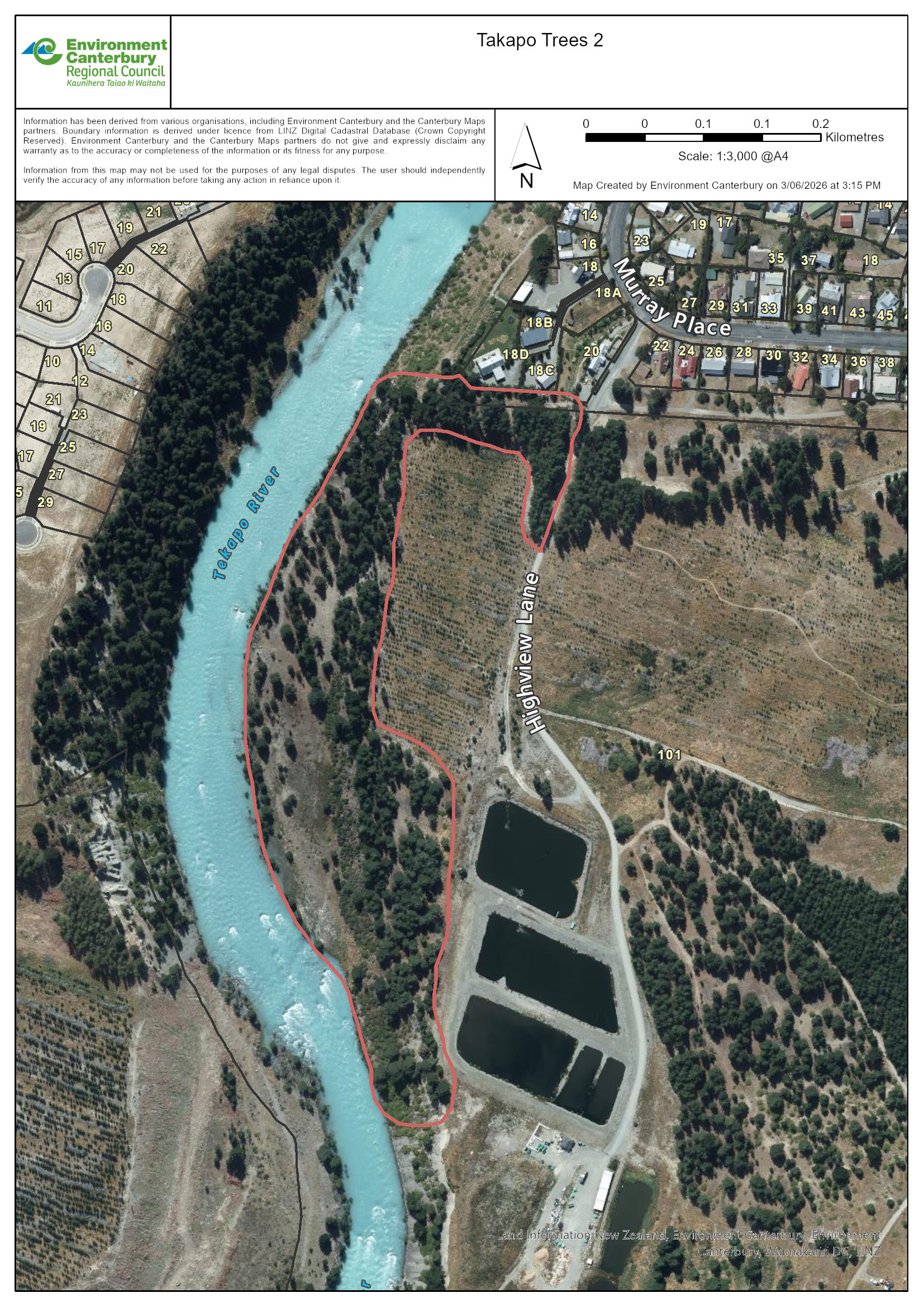
Tree maintenance work along the Takapō River
Hakatere Lake Hood Berm
Where: Above Lake Hood, true right berm. The site will be accessed via Boundary Road.
What: We will carry out mulching and vegetation scraping using a tractor-mounted mulcher and an excavator to clear vegetation, in preparation for native planting as shown on the attached site plan. The purpose of native planting at this site is to improve vegetation density and vegetation diversity, and to help manage weeds in the long term by establishing permanent shade.
Two areas of approximately 2500m² each will be cleared and planted under the willow canopy, within the areas shown by the green polygons on the site plan. One or two areas, totalling 1000m² will be cleared for geotextile planting as shown by the blue polygons on the site plan. During site preparation, the contractor will install hazards and safety signs at both ends of the walking track and will have a spotter present. The track may need to be closed for a couple of hours on two separate days to allow machinery to access and leave the site.
When: Site preparation will take place in late April and May this year and is expected to take five days. Planting will be carried out between mid-June and mid-August 2026 over two to three weeks.
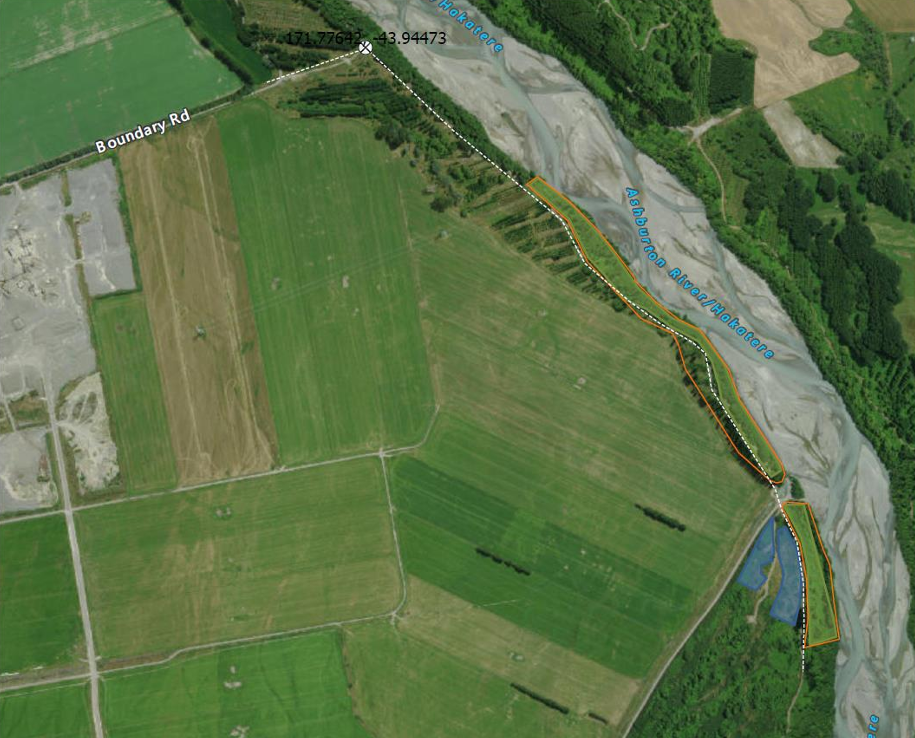
Hakatere Lake Hood Berm - Site Preparation for Native Planting and Native Planting
Rakitata/Rangitata South Branch stopbank construction
Where: South Branch of the Rangitata/Rakitata River, to the west of SH1, near Arundel-Rangitata Rd
What: We will be constructing new stopbanks at three locations (shown in Figure 1) on private land. The works also include realigning an existing stock water race and installing two new culverts. The gravel used to construct the stopbanks will be taken from the main branch of the Rakitata/Rangitata River, north of the site.
These works are designed to improve flood protection for the local community by reducing the risk of overland flooding when the South Branch is flowing. This will help protect nearby homes, farmland, and
key infrastructure, including State Highway 1 and the railway line. Construction materials may be transported along public roads, and traffic management will be in place where required.
When: April 20th to end of October 2026, during dry weather.
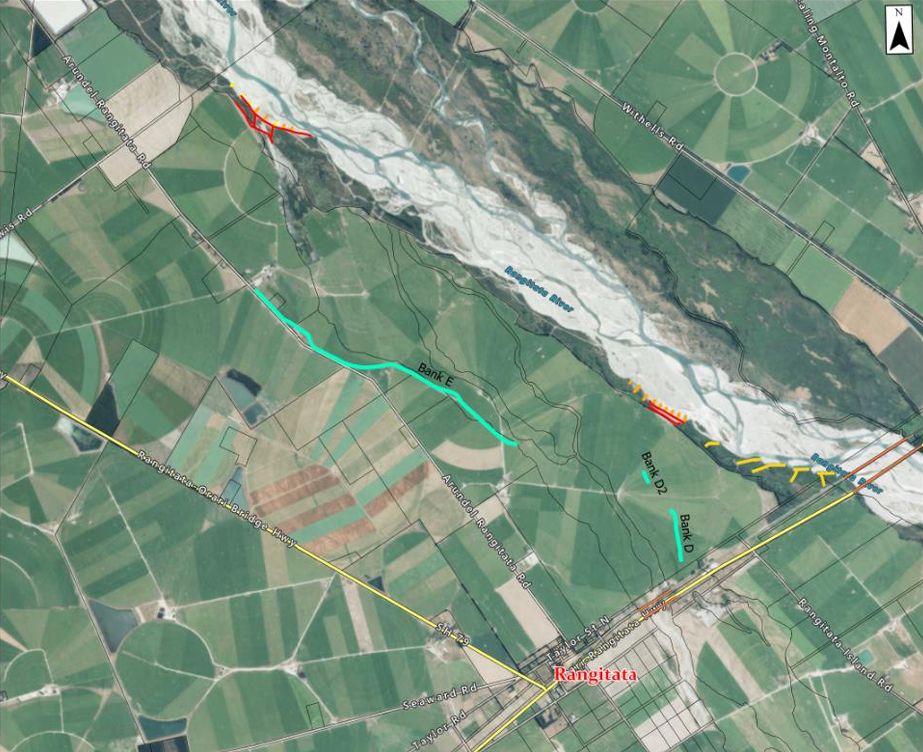
Proposed new stopbank locations for Banks D, D2 and E along the Rangitata River
Forestry Harvesting at ‘Grassy Banks’ site on Ōpihi River
WHAT: We are harvesting of around 27 hectares of poplar forest on the southern bank of the Ōpihi River. The area is being harvested for timber and will be replanted in another forestry crop, the species is to be confirmed.
Parts of the river, including access tracks and roads, will be closed to the public while harvesting takes place.
WHERE: The poplar forest is on the Southern side of the Ōpihi River at the top of Seadown Road, between the SH1 bridge and Waipopo Road.
WHEN: The harvesting crew are aiming to start on the week of 2 March 2026. The operation is expected to take 15 weeks.
WHY: These poplars were planted for flood protection. As they have matured, harvesting them is now the best way to manage the trees and make use of their value. The income generated will be reinvested into flood protection work across the Ōpihi catchment.
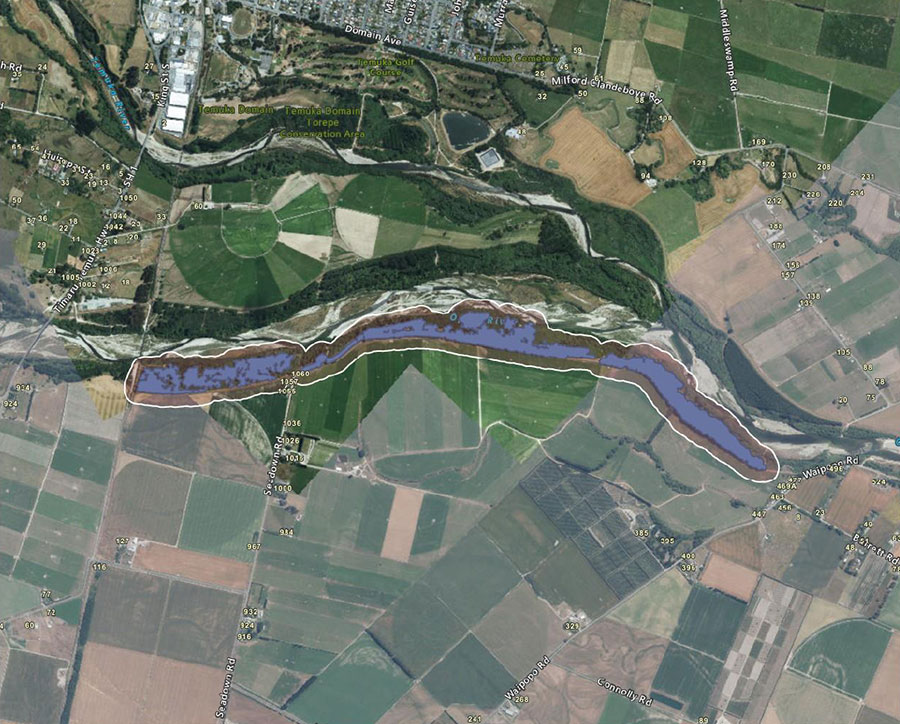
The area of work is in blue
Courtenay Stream floodgates construction
WHAT: Replacing the Courtenay Stream floodgates in Kaiapoi
WHERE: At the confluence of Courtenay Stream and the Kaiapoi River
WHEN: Work begins the week of 2 February 2026 and is expected to be completed by end of December
The current floodgates were built in the 1940s and are now due for renewal.
This upgrade is co‑funded through the Government’s Regional Infrastructure Fund (RIF), administered by Kānoa – the Regional Economic Development & Investment Unit. It also forms part of our 30‑Year Infrastructure Strategy (30YIS), which accelerates essential flood‑protection upgrades across the region.
The project includes removing the old structure and building new floodgates in the same location, starting with environmental controls, site setup, fencing, and public access changes. The upgraded structure will improve flood resilience, make maintenance safer for staff, and provide much better fish passage.
To keep the stopbank track open during construction, a temporary bridge will be installed over Courtenay Stream next to the work area.
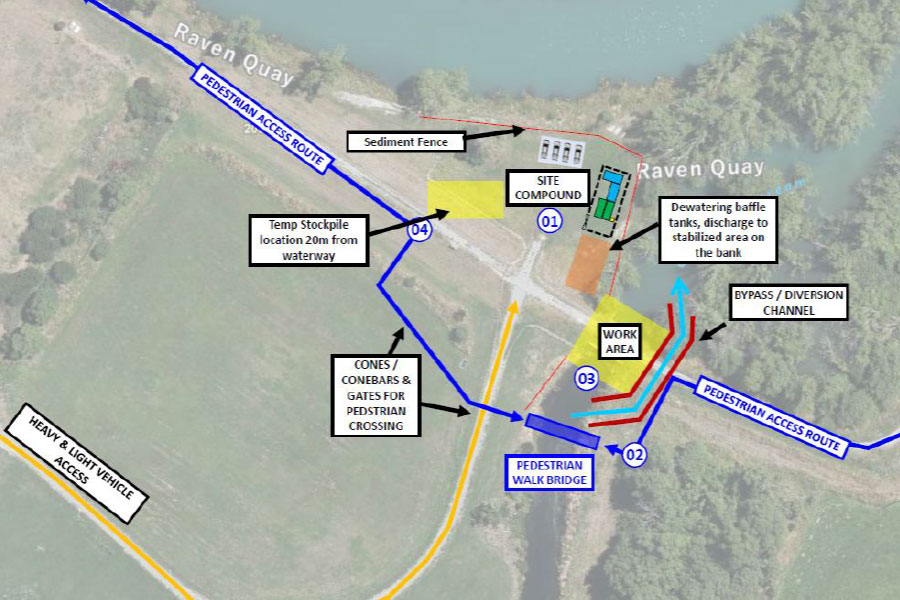
The different work areas