
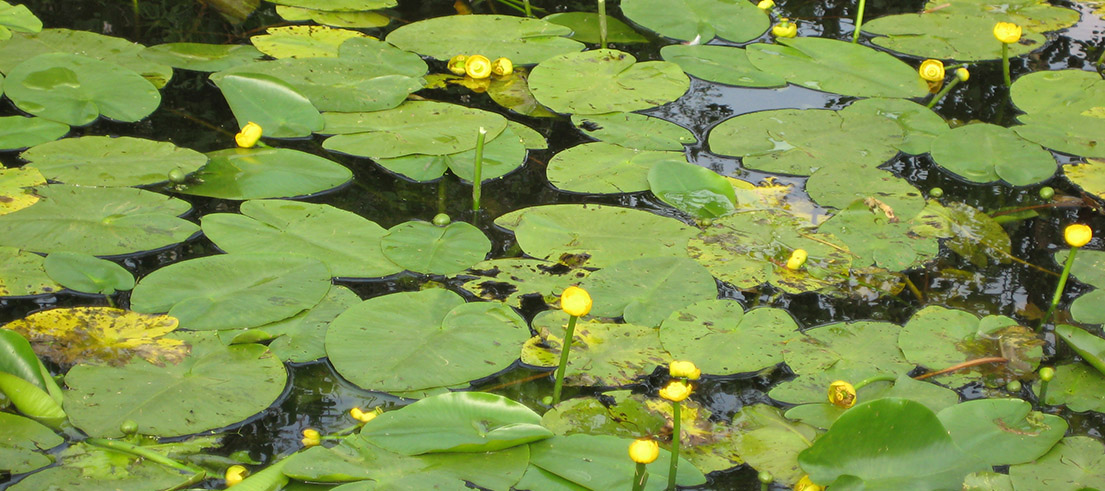
Breakthrough in battle against invasive yellow water lily
After more than a decade of challenging mahi, our biosecurity team may finally have a breakthrough in the fight against an aquatic invader in South Canterbury.
The Yellow water lily (Nuphar lutea), a bottom-rooted aquatic plant known for forming thick, smothering mats, has plagued a spring-fed stream since it was first discovered in 2012. This infestation is the only known site not only in Waitaha/Canterbury but across New Zealand, making it a high-priority target under the Canterbury Regional Pest Management Plan 2018-2038 Eradication Programme, which aims to eliminate it completely by 2028.
Despite repeated efforts using herbicides and hessian matting, the invasive lily continued to thrive, largely due to its thick, stubborn rhizomes—underground stems that resist conventional treatments. However, 2025 has brought new hope.
A new approach to the problem
Earlier this year, the team secured resource consent to carry out sediment discharge as part of a new control method: mechanical excavation. For the first time, an excavator was used to physically remove the plants, roots and all, during the late summer when water levels were at their lowest.
Senior biosecurity officer Gerrit Roux says the new control method is a game changer.
“By getting to the root of the problem we’re seeing the kind of impact we’ve been working toward for years,” he said.

Using an excavator to remove yellow water lily
Hope for the future of yellow water lily control
The mechanical approach wasn’t without its challenges. Stirred sediment reduced visibility in the water, and managing the volume of material removed required careful handling. Still, the operation went ahead successfully, and the team believe it could dramatically reduce the infestation - potentially by as much as 50 to 70 per cent.
However, the real test lies ahead. The lilies enter dormancy during winter, and the true results of the intervention won’t be clear until spring and early summer, when any surviving plants begin to regrow.
Encouraged by early indications, staff are already planning to refine and repeat the mechanical control method in summer 2025/26. If successful, this could place Waitaha back on track to meet the eradication goal by 2028.