
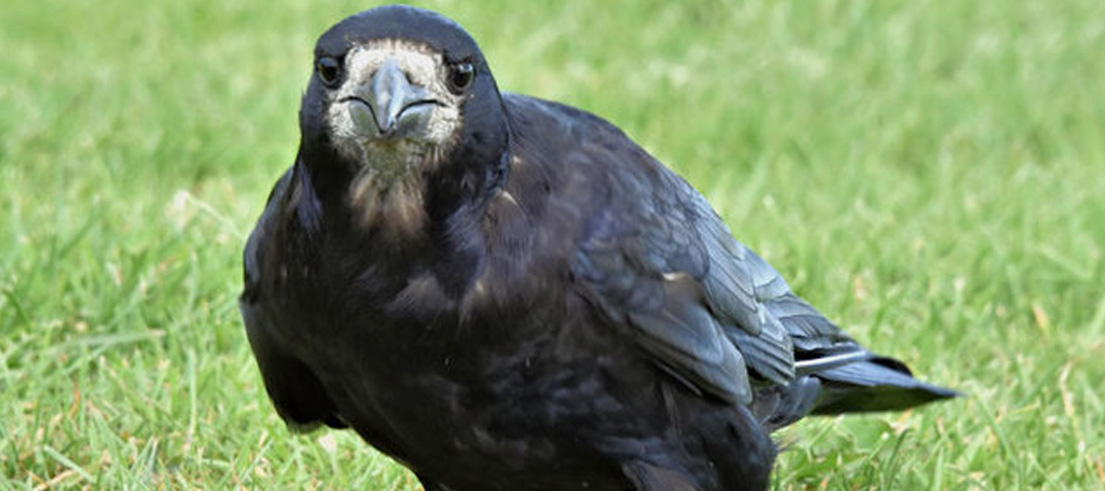
Report rook sightings in North Canterbury
Just when we thought rooks had flown the coop in Waitaha Canterbury, a recent sighting in North Canterbury has biosecurity staff asking the public to keep their eyes and ears open.
A possible rook was reported near Hawarden earlier this month, prompting Canterbury Regional Council (Environment Canterbury) biosecurity officers and contractors to visit the area and investigate.
While it's not yet clear whether the bird was simply passing through or has decided to stick around, one thing is certain: early reports give us the best chance of responding quickly.
Why this sighting matters
Environment Canterbury Biosecurity Officer Rob Kent says community reports are critical to helping locate any remaining birds.
"Rooks are highly intelligent and extremely wary, which means they can be difficult to find and control," says Rob.
"The public plays a vital role in helping us track down any remaining rooks. If you spot a bird that looks or sounds like a rook, report it as soon as possible. The sooner we know about it, the better our chances of locating it and responding effectively."
Rooks are a declared pest in our region. They can cause significant damage to newly sown crops by pulling up seeds and young plants while feeding and can also damage pasture by tearing up the ground in search of insects and grubs.
For decades, Environment Canterbury has worked to completely eradicate rooks from the region. Once numbering in the thousands across parts of Canterbury, these birds are now rarely seen thanks to sustained control efforts and support from local communities. However, ongoing vigilance is needed to stop rooks from re-establishing and undoing years of progress.
What does a rook look like?
Rooks are members of the crow family and can be identified by:
- Glossy black feathers with a purple-blue sheen
- A pale grey, featherless patch around the base of the beak
- A distinctive "kaah" call
- Fluffy feathers on their legs make it look like they are wearing trousers
- Larger size than a magpie.
Seen one? Let us know immediately.
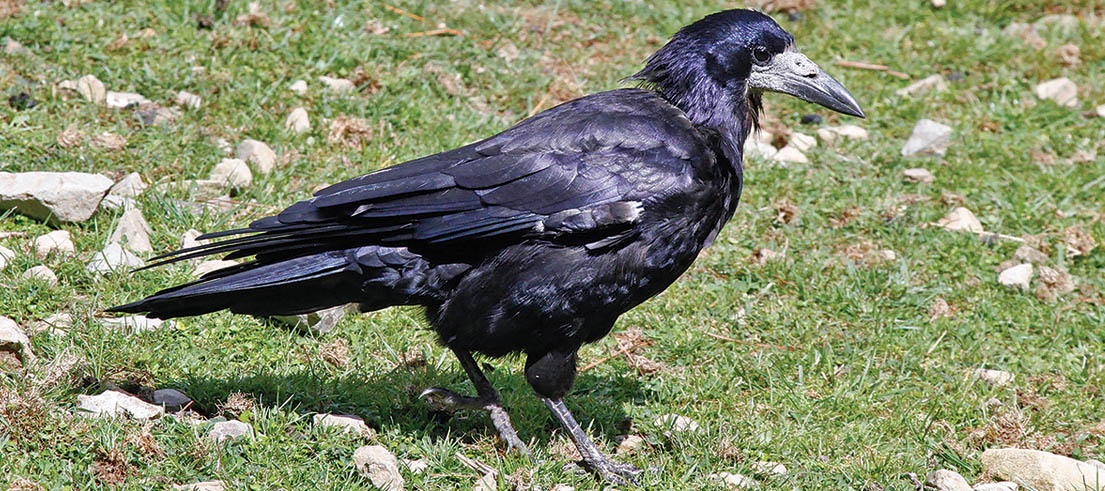
Rook - Photo credit: Duncan Watson
If you think you've spotted a rook:
- Take a photo if you can do so safely
- Note the location
- Call Environment Canterbury on 0800 324 636
Please don't approach or attempt to shoot the bird. Rooks are highly mobile and can quickly move on if disturbed, making them much harder to locate and control effectively.
Your reports could help us respond quickly and support Canterbury's ongoing rook eradication efforts.
Why does Environment Canterbury eradicate rooks?
Rooks (Corvus frugilegus) are an introduced bird species that were brought to New Zealand from Europe during the 1860s and 1870s to help control insect pests (Bull & Porter, 1975; NPCA, 2020). However, they quickly established breeding populations and became a pest species themselves. In 2000, rooks were officially declared an Unwanted Organism under the Biosecurity Act and today are managed across 13 regions of New Zealand (MPI, 2000; MPI New Zealand Established Pests Portal).
Why are rooks an agricultural pest?
The main reason rooks are targeted for eradication is the damage they can cause to agricultural production, particularly arable farming.
Unlike many bird species that feed individually, rooks feed communally and often return repeatedly to the same food source until it is exhausted (NPCA, 2020). They are known to pull out newly germinated crops, eat freshly sown seed, and damage a variety of crops including cereals, maize, peas, broad beans, potatoes, pumpkins, walnuts and apples (Porter, 1979; Purchas, 1980; Heather & Robertson, 1996).
Research has shown that while newly sown crops make up only a small proportion of their overall diet, rooks can cause disproportionately high damage because they feed in concentrated flocks. Studies found that 100 rooks can strip approximately one hectare of newly sown seed in as little as 15 days (Purchas, 1980). Large seeds planted in rows, such as maize, are particularly vulnerable.
A flock of 200 rooks represents around 80 kilograms of actively feeding bird biomass moving through a landscape (NPCA, 2020). When these birds target newly emerging crops, losses can occur quickly and farmers often have little opportunity to intervene before damage has been done.
What are the economic impacts of rooks?
While there are relatively few modern studies quantifying rook impacts in New Zealand, the available evidence consistently identifies rooks as a source of agricultural loss (Cowan et al., 2010; Krull et al., 2015).
Historically, surveys of Hawke's Bay growers estimated losses and control costs of approximately $153,900 during a single cropping season in 1969/70 (Cowan et al., 2010). Overseas research has also demonstrated measurable impacts. A Scottish study found rooks were responsible for approximately 35% of barley losses and 3.2% of oat losses in the areas studied (Feare, 1974).
While exact impacts vary between seasons and locations, Environment Canterbury considers the potential risk to Canterbury's extensive arable sector significant enough to justify ongoing control.
Do rooks provide any benefits?
Rooks do eat insects and other invertebrates. Around 40% of their feeding activity can involve invertebrates such as grass grub, and this can rise to as much as 75-80% during spring (Purchas, 1980).
Research suggests rooks may consume some agricultural pest species including grass grub, armyworm, black field cricket and white-fringed weevil (McLennan & MacMillan, 1983; Purchas, 1980). However, the available evidence indicates these benefits are limited.
For example, a study examining rook predation on grass grub found rooks removed only around 15-22% of grass grubs present. Most grass grubs remained beyond the depth at which rooks could access them. The researchers concluded that rook predation did not prevent pasture damage because grass grub populations remained well above levels known to cause economic losses (McLennan & MacMillan, 1983; Ferguson et al., 2019).
In other words, while rooks do eat some pest insects, the evidence does not show they provide sufficient pest control to offset the damage they cause to crops.
Importantly, rooks do not selectively eat pest species.
Studies have shown that earthworms are a preferred food source, while flies, beetles, bees, spiders and other beneficial invertebrates are also consumed (Porter, 1979; Purchas, 1980). Many of these species contribute to soil health, nutrient cycling, pollination and ecosystem function.
The economic value of these losses has not been fully quantified, but they further reduce any potential argument that rooks provide a net environmental benefit.
Why is eradication now achievable?
After decades of coordinated control, rook numbers in Canterbury are now extremely low.
At low population levels, eradication becomes more practical and cost-effective than long-term management. Allowing the remaining birds to establish breeding populations would risk population recovery and a return of the agricultural damage previously experienced by farmers (Harris, 2017; Cowan et al., 2010).
This is why the Canterbury Regional Pest Management Plan classifies rooks as an exclusion pest. The aim is not simply to keep numbers low, but to prevent breeding populations from becoming established and ultimately remove the species from the region.
Independent analysis confirms eradication is achievable
A cost-benefit analysis prepared for Environment Canterbury found that the estimated benefits of avoiding rook-related damage outweighed the costs of inspection, monitoring and control (Harris, 2017).
The analysis estimated:
- Direct control costs of approximately $50,000-$79,000 (net present value).
- Avoided agricultural losses of approximately $100,000-$140,000 (net present value).
- The analysis concluded that continued control delivered a net benefit to Canterbury's arable and pastoral sectors (Harris, 2017).
References
Bull, P.C. & Porter, R.E.R. (1975). Distribution and numbers of the rook (Corvus frugilegus L.) in the North Island of New Zealand.
Cowan, P., Booth, L., Duckworth, J., & Glen, A. (2010). Future options for the management of rooks (Corvus frugilegus). Landcare Research.
Feare, C.J. (1974). Ecological Studies of the Rook in North-East Scotland. Damage and Its Control.
Ferguson, C.M. et al. (2019). Quantifying the economic cost of invertebrate pests to New Zealand's pastoral industry.
Harris, S. (2017). Analysis of costs and benefits. Prepared for Environment Canterbury.
Heather, B. & Robertson, H. (1996). The Field Guide to the Birds of New Zealand.
Krull, C.R., Galbraith, J.A., Glen, A.S., & Nathan, H.W. (2015). Invasive vertebrates in Australia and New Zealand.
McLennan, J.A. & MacMillan, B.W.H. (1983). Predation by the rook on larvae of the grass grub in Hawke's Bay, New Zealand.
National Pest Control Agencies (NPCA). (2020). A6 Pest Rooks Monitoring and Control.
Porter, R.E.R. (1979). Food of the rook in Hawke's Bay, New Zealand.
Purchas, T.P.G. (1980). Feeding ecology of rooks on the Heretaunga Plains, Hawke's Bay, New Zealand.
Ministry for Primary Industries. Corvus frugilegus (Rook) Pest Register and New Zealand Established Pests Portal.