
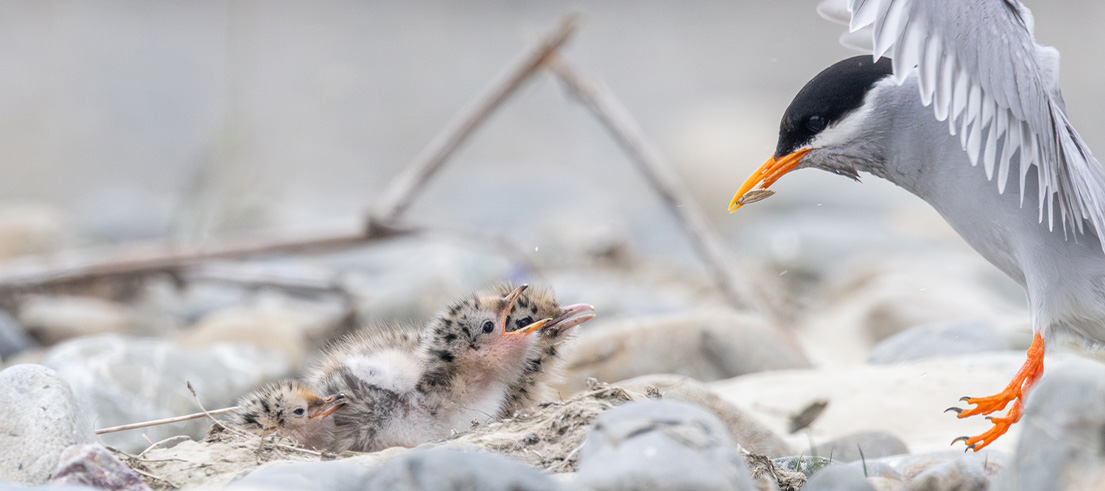
Give braided river birds space this nesting season
Whether you're walking the dog, casting a line, riding a motorbike or heading out in a 4WD, a little extra care on Canterbury's rivers can help protect braided river birds this spring.
Braided river bird nesting season has begun, and some of our most threatened native birds begin nesting and raising their chicks on riverbeds across the region.
Each spring and summer, thousands of birds nest on the wide gravel beds of the Waimakariri, Rangitata, Rakaia, Ashley Rakahuri and other Canterbury rivers. But spotting them isn't easy. Their eggs and chicks are remarkably well-camouflaged among the stones, which helps protect them from predators, but also makes them vulnerable to disturbance from dogs, people and vehicles passing through.
Species including ngutu pare/wrybill, pohowera/banded dotterel, tarapirohe/black-fronted tern and tarāpuka/black-billed gull depend on Canterbury's braided rivers for nesting habitat.
Canterbury Regional Council (Environment Canterbury) Principal Biodiversity Advisor Frances Schmechel said giving the birds space is one of the simplest ways we can help them successfully raise their chicks.
“You may not realise there is a nest or chick nearby until it’s too late. A vehicle, an off-lead dog or even someone walking through a nesting area can disturb adult birds, causing them to leave their nests, or can accidentally destroy a well-camouflaged nest.”
Some species, including wrybill, banded dotterel and oystercatchers, will quietly slip off their nests when people get too close, so you may never know they were nesting there in the first place.
Dogs are particularly disruptive because they can cause birds to leave their nests from much further away. They may also chase or kill chicks, so it’s important to keep dogs on a leash and away from nesting areas.
“The best thing people can do is stick to established tracks, preferably away from the riverbed, avoid driving on riverbeds and give nesting birds plenty of space.”
Why braided river birds need protection
Life on a braided river is already challenging. Eggs and chicks face threats from predators, such as stoats, cats and Southern black-backed gulls, while weeds and changes to river flows can reduce the open gravel habitat many species need to nest successfully.
Environment Canterbury, the Department of Conservation (DOC), and community groups such as the Ashley Rakahuri Rivercare Group are working together to give these birds a fighting chance.
From predator and weed control, to habitat restoration and monitoring, this work helps protect the fragile ecosystems braided river birds depend on.
“Canterbury’s braided rivers are one of the rarest ecosystems on the planet. We can’t afford to lose the birds that depend on them, like the wrybill and black-fronted tern," Frances said.
"Protecting their habitat is a responsibility we all share, and a few simple choices when visiting the river can make a real difference.”
Rare birds that rely on Canterbury’s braided rivers
Canterbury's braided rivers are home to some extraordinary species.
Ngutu pare/wrybill are the only birds in the world with a bill curved sideways. They use it to reach insect larvae beneath rounded riverbed stones. Like tarapirohe/black-fronted terns, they rely on braided rivers in the South Island for breeding.
“Every person who visits a braided river has a role to play," Frances said.
“Remember that you’re sharing space with some of our most threatened native species. Giving them space might seem like a small thing, but it can mean the difference between a chick surviving or being lost."
Protect nesting birds when you visit a river
- Avoid nesting birds and give them plenty of space
- Stick to established tracks where possible, preferably away from the riverbed
- Avoid driving on riverbeds during the nesting season (September to February)
- Keep dogs on a leash and away from nesting areas
- Take your rubbish home
- Report animal pests or other threats you notice
- Support the work of local rivercare and conservation groups.