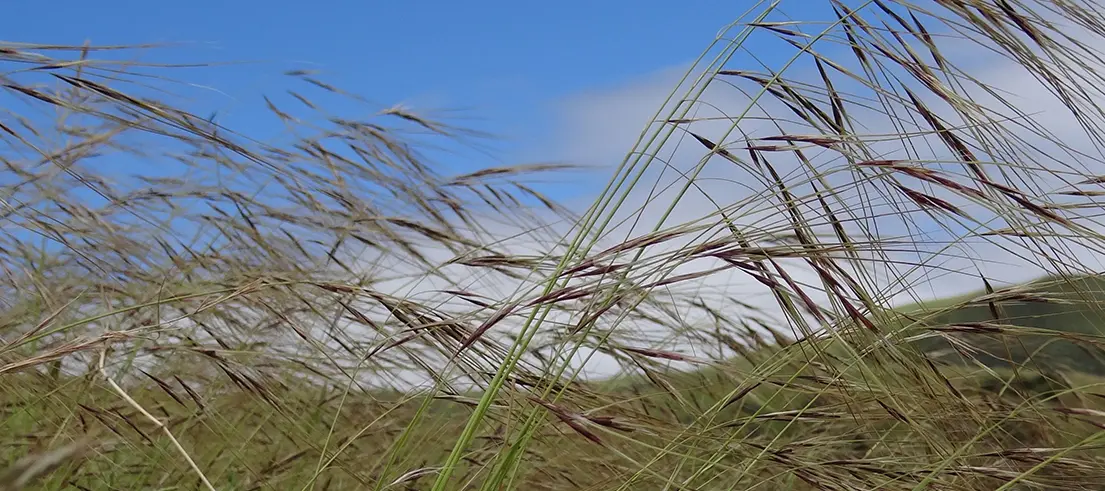
Seeing purple in your paddock? It could be Chilean needle grass
As Chilean needle grass begins to flower across Waitaha Canterbury, we’re asking people to keep an eye out for this invasive pest plant and report anything suspicious.
Chilean needle grass is most easily identified from late November and December when its distinctive purple-red, drooping flower heads begin to appear. While known populations are concentrated in parts of North Canterbury, it has also been found around West Melton and on Banks Peninsula, making early detection important for preventing further spread.
What does Chilean needle grass look like?
Chilean needle grass is an upright, perennial grass that can grow to around one metre tall.
At this time of year, look for:
- large, drooping flower heads with a distinctive purple or reddish colour
- bright green leaves that are flat and rough towards the base
- hard, hairy seeds with a sharp, needle-like point and long, twisting tails, known as awns, which can grow up to about 8cm long.
As the seeds mature, they fade from purple red to a lighter brown colour.
The plant can be difficult to distinguish from other grasses when it isn’t flowering or seeding, which is why November through summer is the time to keep an eye out.
Senior Biosecurity Officer Noel Crump says you don’t need to be an expert to play an important part in spotting new infestations.
“People might walk or drive past these plants every day without giving them a second thought. We’re asking people to take a closer look at unfamiliar grasses at this time of year, particularly in areas where Chilean needle grass has been found before.
“A photo and a location can be really useful for our biosecurity team. If it turns out not to be Chilean needle grass, that’s a great result,” says Noel.
Why is it a problem?
Chilean needle grass can have serious impacts on farming and animal welfare. Its sharp seeds can penetrate the skin of livestock and may cause painful injuries and blindness. When infestations become established, they can also reduce pasture and crop yields, affect the quality and value of agricultural products, restrict how affected land can be used and be difficult and expensive to control.
The seeds are also very good hitchhikers. They can be spread between properties on livestock and feral animals or carried on clothing, vehicles and machinery, as well as in contaminated soil, mud, hay or feed.
That means finding new infestations early gives us the best opportunity to prevent them from spreading further.
Think you’ve found it? Don’t pull it out
If you see a grass that you think could be Chilean needle grass, please don't pull it out, mow it, spray it or disturb it.
Instead:
- Leave the plant where it is.
- Take a clear photo if you can, including the plant and its flower or seed head.
- Make a note of the location.
- Report it to Environment Canterbury through reportpests.nz or call on 0800 324 636.
Our biosecurity team can confirm whether it is Chilean needle grass and advise on what needs to happen next. Even if you're not sure, we'd rather you report a suspicious plant and let us confirm what it is.