Funding opens 1 September 2026 for community-led projects that protect and restore biodiversity across Christchurch and Banks Peninsula.
Learn how the fund is helping local groups care for native habitats, plants and wildlife.

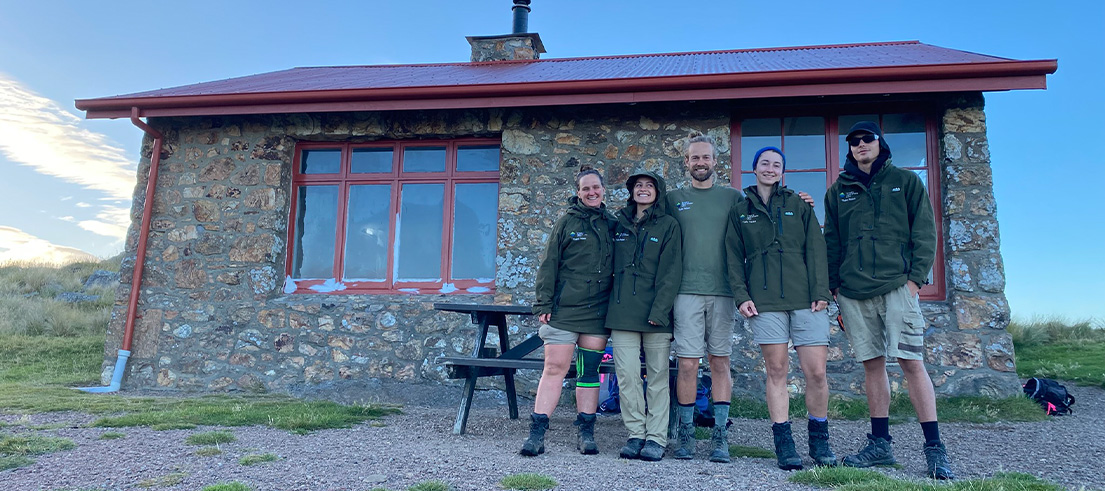
A team from Ngāti Wheke’s Tiaki Taiao field-work crew went to great lengths, or should we say heights, to clear gorse from the summit of Te Ahu Pātiki / Mt Bradley on Banks Peninsula in March.
The group hiked up Te Ahu Pātiki Mt Bradley every day for four days to carry out the work. It’s one of the highest peaks in the wider Ōtautahi Christchurch area, along with Te Ahu Pātiki Mt Herbert.
Their incredible efforts were made possible thanks to $37,117 of funding from Canterbury Regional Council (Environment Canterbury’s) Christchurch and Banks Peninsula Biodiversity Fund and $16,000 from Christchurch City Council’s Biodiversity Fund.
Mt Bradley and Herbert form part of Te Ahu Pātiki, a public conservation park in the heart of Whakaraupō Lyttelton Harbour.
Te Ahu Pātiki was purchased in 2021 following a crowdfunding campaign facilitated by the Rod Donald Banks Peninsula Trust and supported by donations of over $900,000 from more than 3000 individuals and organisations. It is now managed by the Te Ahu Pātiki Charitable Trust, a partnership between the Rod Donald Trust, Te Hapū o Ngāti Wheke, Te Rūnanga o Koukourarata, and Orton Bradley Park.
Te Ahu Pātiki is protected by a QEII Covenant. It’s home to a variety of nationally and regionally rare plant and lichen species, some of which are under threat from gorse incursion.
On many parts of Banks Peninsula, such as Hinewai Reserve, gorse is largely left to act as a nurse crop which assists native regeneration to forest.
This unmanaged approach is also being taken across the majority of Te Ahu Pātiki. However, some of the special species of Te Ahu Pātiki are adapted to open, non-forested environments, and therefore management of the gorse is needed in these areas.
Te Ahu Pātiki has the highest known wetland system on Te Pātaka o Rakaihautū Banks Peninsula. This wetland system is also threatened by gorse cover. This gorse control work also complements other weed control efforts in Te Wharau catchment.
The Whaka-Ora Healthy Harbour programme and Te Ahu Pātiki Charitable Trust (through Macpac sponsorship) funded the same Tiaki Taiao crew to remove the weed old man's beard (Clematis vitalba) from Te Ahu Pātiki in 2025.
Funding from Environment Canterbury and Te Ahu Patiki has also targeted Banks Peninsula’s largest known Spanish heath (Erica lusitanica) infestation on the slopes of Te Ahu Pātiki Mt Bradley.
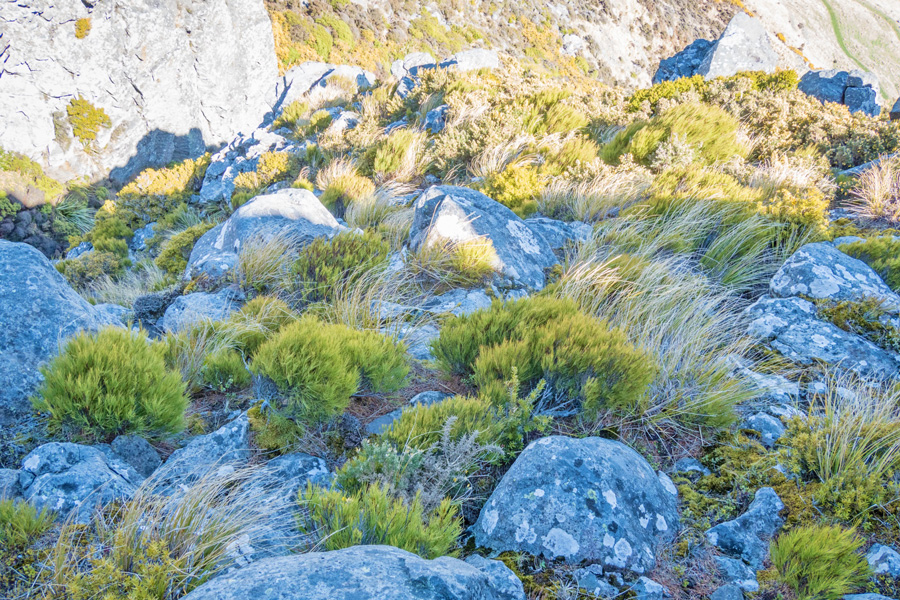
Dracophyllum and snow tussock (Carmichaelia rigida)
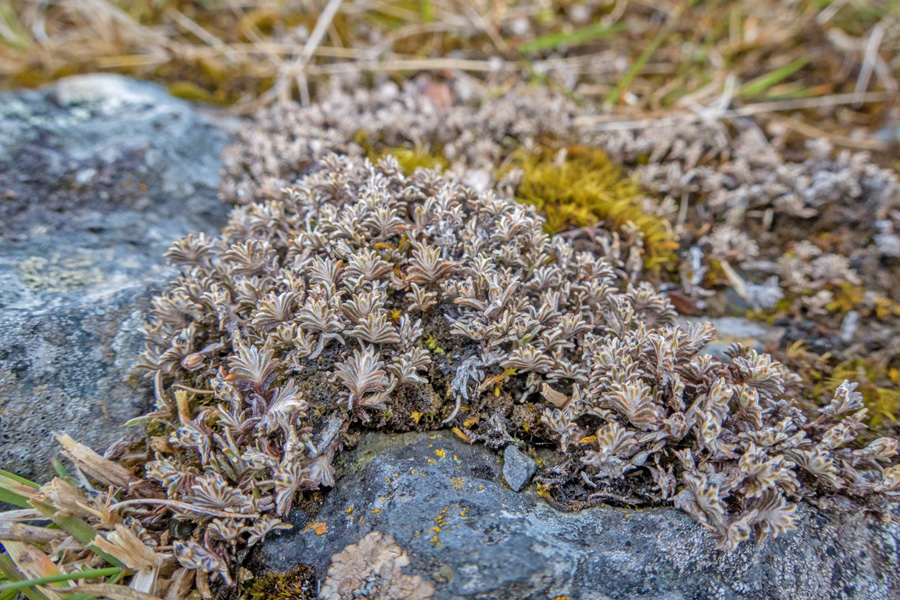
Fan-leaved mat daisy (Raoulia monroi)
Due to how difficult it was to access Te Ahu Pātiki Mt Bradley, the Tiaki Taiao team stayed at the Sign of the Packhorse Hut for four days. The Department of Conservation granted them access to drive up to the hut via the Kaituna valley. Once at the hut, the team still had a one hour, 360m climb up and down the maunga each day. They did this while carrying weed eaters, tools and supplies.
The team carried out 200 hours of work, clearing the immediate Te Ahu Pātiki Mt Bradley summit of gorse. Special attention was given to rocky outcrops on the northern face. A track was also maintained and opened up along its entire length, with grass and gorse cleared that had taken over and smothered walking access.
The epic Te Ahu Pātiki Mt Bradley effort is not the only gorse control work that has taken place at Te Ahu Pātiki recently. Extensive work has also been done on the summit of Te Ahu Pātiki Mt Herbert. Before and after photos show the positive impact of this work.
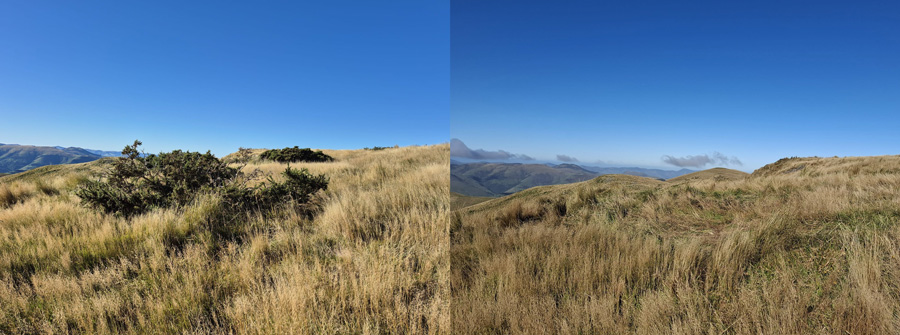
Before and after gorse control on Te Ahu Pātiki / Mt Bradley
Te Ahu Pātiki Charitable Trust Kaituitui (coordinator and organiser) Sarah Anderson said the project would not have been possible without the funding from Environment Canterbury and the Christchurch City Council.
“It wouldn’t have happened without it, it’s as simple as that,” she said.
Sarah said without work to clear gorse on the two summits of Te Ahu Pātiki, precious plant species would not survive.
“The work enhances and protects those open-space areas on the summits to allow them to continue to exist, because they would get subsumed if we didn’t do this – they would disappear.
“There’s a whole list of rare plant species up there that are worth protecting.”
Sarah said it will take some time to judge how effective the gorse control on both summits has been. She said the work is far from over, with funding applications already underway to ensure the fight against gorse in the area can continue.
“It [the gorse control work] is quite recent, so we just need to give it a bit of time to see the effects.
“We are going to be reviewing the effects of all of this work in another five years or so. Nature is a slow thing. It’s work that we need to do more of, it’s not finished by any means, this is the first big push. We will just keep at it as much as we can fund it.”
Sarah said other great work to clear gorse and old man’s beard on Te Ahu Pātiki Mt Bradley had been carried out by the field crew from Orton Bradley Park.
Learn more about the organisations and places supporting biodiversity work on Te Ahu Pātiki and Banks Peninsula.