
Managing your rubbish pit
Rubbish pits can present significant environmental risks if not properly located, constructed, or managed. This guidance outlines best practices for design, permitted use, and regulatory requirements to help you stay compliant and protect land and water quality.
If your property is over 20 hectares, you are permitted to have a rubbish pit to dispose of your household and farm waste, if no local authority refuse collection exists. Residual waste that cannot be recycled or reused, is best disposed of at your local transfer station. An on-farm pit should only be used as a last resort.
Environmental risks of rubbish pits
Rubbish pits can contribute to contamination of land and water if poorly managed. Risks include:
- leaching into groundwater from hazardous waste
- run-off into streams, bores, and critical source areas
- odour and pests from exposed or decomposing material
- cultural impacts on mahinga kai, wāhi tapu or wāhi taonga if located within sensitive areas.
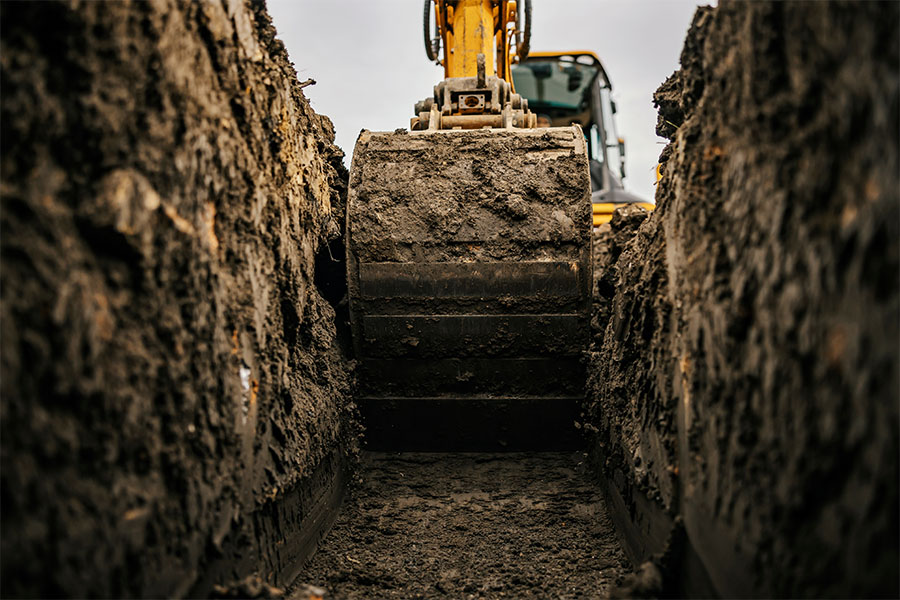
Designing a rubbish pit
Minimising these risks starts with good site selection, design, and ongoing maintenance.
Your rubbish pit must be:
- At least 100 metres away from:
- Surface water
- Water abstraction bores
- Property boundaries
- The coastal marine area
- Outside:
- Community Drinking-Water Protection Zones
- Listed archaeological sites
- Residential, commercial, or industrial zones
- On elevated land, with no risk of surface water entry
- Avoiding gullies, poor-draining soils, flood-prone or ponding areas
- Above groundwater: The highest groundwater must be at least 4 m below ground level
- With a base buffer: 3 m of sand or soil (not gravel) between pit base and groundwater
Rubbish pit usage and maintenance
You may only dispose of waste generated on your property. Good management includes:
- Volume: Must be under 50m³
- No burning: Burning waste in pits is prohibited
- Covering: When full or no longer in use, cover with at least 0.5 m of soil or an impermeable lid
- Monitoring: Check regularly for leaks, overfilling or hazards
- Stock control: Fence off to prevent animal access
- Waste preference: Always prioritise recycling, reuse, and transfer stations before pit disposal
Rules and regulations for rubbish pits
Rubbish pit rules are set under the Canterbury Land and Water Regional Plan:
- Refer to Rules 5.27–5.28A for regional guidance
- In the Selwyn Waihora sub-region, Rule 11.53 applies in addition where pits may affect cultural values in designated areas
If you cannot meet the permitted activity rules, you will need to apply for resource consent.
Read the rules 5.24–5.28 for regional guidance on rubbish pits
General rules
- In addition to the provisions of the Canterbury Land Water Regional Plan and any relevant district plan, any activity which may modify, damage or destroy pre-1900 archaeological sites is subject to the archaeological authority process under the Heritage New Zealand Poutere Taonga Act 2014. An archaeological authority is required from Heritage New Zealand to modify, damage or destroy any archaeological site, whether recorded or not in the New Zealand Heritage List/Rārangi Kōrero website.
5.27: Permitted activity conditions for on-farm rubbish disposal
The discharge is to a pit:
-
- located on a site of greater than 20 hectares in area
- with a volume of less than 50 m3
- sited and designed to prevent surface runoff from entering the pit
- designed to prevent animals from gaining access to the pit.
- no hazardous substances, agrichemicals or agrichemical containers are discharged
- discharge is only of refuse produced on the property where the pit is located
- no kerbside community or local authority refuse collection is available
- when any pit is filled to within 0.5 m of the original land surface, or is no longer used, the contents are covered with soil to a depth of at least 0.5 m or the pit is covered with an impermeable lid.
The discharge does not occur:
-
- within 100 m of a surface water body, a bore used for water abstraction, the boundary of the property or the Coastal Marine Area
- within a Community Drinking-water Protection Zone as set out in Schedule 1
- unless there is at least 3 m of soil or sand between the point of discharge and the highest groundwater level
- within the Christchurch Groundwater Protection Zone as shown on the planning maps
- onto or into land listed as an archaeological site
- within any area or zone identified in a proposed or operative district plan for residential, commercial or industrial purposes.
5.28: When a rubbish pit requires resource consent
The use of land for an on-site rubbish disposal pit and the associated discharges onto or into land in circumstances where a contaminant may enter water that does not meet one or more of the conditions in Rule 5.27 is a restricted discretionary activity where the following condition is met:
The disposal and discharge are the subject of a Farm Environment Plan that has been prepared in accordance with Schedule 7, Part A.
The exercise of discretion is restricted to the following matters:
- the actual or potential environmental effects of not meeting the condition or conditions of Rule 5.27
- the actual or potential environmental effects of the discharge on the quality and safety of human and animal drinking water
- the quality of, compliance with, and auditing of the Farm Environment Plan,
- any adverse effects on Ngāi Tahu values, or sites of Ngāi Tahu significance, including wāhi tapu and wāhi taonga.
5.28 A The use of land for an on-site rubbish disposal pit and the associated discharges onto or into land in circumstances where a contaminant may enter water that does not meet the condition of Rule 5.28 is a discretionary activity.
5.28A: When a rubbish pit becomes a discretionary activity
Meeting consent conditions and audit expectations
Consent monitoring: If you hold a discharge or land use consent:
- A Resource Management Officer (RMO) may visit to assess compliance.
- This includes permitted activities such as rubbish pits, silage pads and offal pits.
- You must be able to show evidence of compliance at any time, including photos, records, and disposal receipts.
Farm Environment Plan audits: Rubbish pits are also considered point source risks in your Farm Environment Plan (FEP). During FEP audits, auditors check that all silage, offal, and rubbish discharges are:
- properly sited and managed
- not discharging to surface or groundwater
- minimising risks to mahinga kai and water quality.
Important: A passing FEP audit does not mean you are compliant with your consent conditions. RMOs are responsible for consent compliance and may request records during inspections. Use our consent search tool to review your conditions and make sure you're meeting them.
FEP audits vs. consent compliance
Compliance monitoring is a separate process from a FEP farm audit. Receiving a passing grade for your FEP does not automatically mean you are compliant with your consent conditions.
A Resource Management Officer (RMO) will monitor the FEP condition (which is just to ensure there is an FEP), but they do not monitor the content of the FEP audit. Compliance with consent conditions can only be determined by our RMOs.
Key differences:
- An FEP is about managing the risk of your farming practices
- Consent compliance is about meeting specific rules and conditions
| FEP audits | Consent compliance |
|---|---|
|
Focus on environmental risk management Required under regional planning rules for some farm types May get an A-grade FEP, but still fail consent condition monitoring |
Focus on meeting legal conditions Enforced by council RMOs Consent condition monitoring is done independently of an FEP audit |
Need help? Look up your consent conditions using your consent number on our consent search tool.