Our biosecurity team is available to provide advice on nassella tussock identification, control and management for all landowners in Canterbury.
If you have any questions contact us on 0800 324 636 or email biosecurity@ecan.govt.nz.

Nassella tussock is an invasive grass that is spreading in Canterbury. It displaces other grasses leaving pasture unpalatable to stock. We use specific control measures to prevent its spread and reduce the impact on farmland and people's livelihoods.
✔ Plan your control work
✔ Book contractors early
✔ Control plants before they seed
For decades, landowners, contractors, rural communities and Environment Canterbury have worked together to reduce the impact of nassella tussock across Canterbury.
While the pest remains well established in some parts of the region, it continues to be found in new areas. Ongoing control and early detection are critical to limiting its spread and protecting productive farmland.
If you have nassella tussock on your property, you're responsible for controlling it under the Canterbury Regional Pest Management Plan.
In Canterbury, there are currently more than 1450 properties where nassella tussock has been found, or has previously been found. This covers over 400,000 hectares.
We are working with the community and landowners to identify nassella tussock, control and prevent seeding, find new infestations, prevent its spread and reduce impacts on production. This a challenging job as mature plants can produce up to 100,000 seeds. These seeds are dispersed to neighbouring land by wind, water, stock, clothing and machinery.
While most seeds released annually last only one to two years on the ground, some can last much longer. It can take three-to-four years after a seed has germinated for a plant to grow large enough to be detectable.

The dense nassella tussock perennial
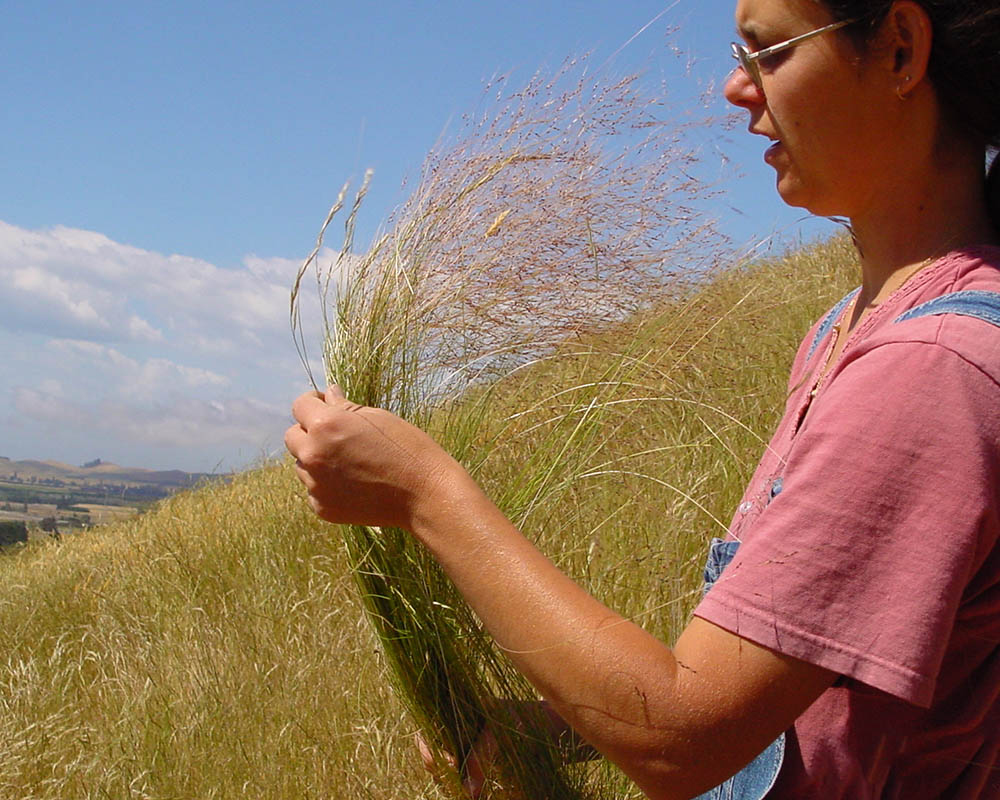
Fine, wiry leaves rough to the touch

Purple seeds usually visible from October–December.
Read more about nassella tussock (Nassella trichotoma), how to spot it, the conditions it thrives in and why it's a problem.
While much of Canterbury's nassella tussock is concentrated in North Canterbury, infestations continue to be found in other parts of the region.
Environment Canterbury is increasing its focus on early detection and identifying infestations in new and at-risk areas, helping prevent the pest becoming established in more parts of Canterbury.
There is no change to the responsibilities of landowners. Annual control remains essential to limiting the spread of nassella tussock.
To sustainably manage nassella tussock throughout the region, land occupiers must annually search their land to identify and eliminate plants.
If you are planning to use a contractor to control nassella tussock this year, we strongly recommend booking this early to avoid any delays.
Some land is more susceptible to nassella tussock infestation, this includes north-facing hillsides and/or free draining soils where dry conditions or pastures open up each year. In these sites, with less competition from other pastures species nassella tussock can flourish.
Even if nassella tussock is not known to be present on land you manage, we recommend you become familiar with identifying plants and be on the look out for it, especially during October–December when seeding makes it easier to identify.
If you find nassella tussock on your property, you will need to dedicate time and/or resources every year to systematically search for and eliminate it, especially in highly susceptible areas.
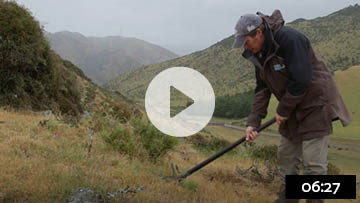
Video: Get ahead of nassella tussock spread
We recommend you inspect your property regularly. We inspect properties every year to ensure that land occupiers who know they have nassella tussock are meeting their obligation to control it.
We recommend you create a nassella tussock map of your property, or work with a contractor to do so. A map will help keep track of areas where plants have been removed, note progress each year, and identify higher density 'hot spots'. Canterbury maps is a helpful tool to use for mapping your property.
To comply with the Canterbury Regional Pest Management Plan (2018–2038), all Canterbury land occupiers are required to remove nassella tussock annually before it seeds. Plants need to be eliminated by 30 September for most properties in Canterbury, or 31 October for high-density infestations in the Hurunui district.
If you need a contractor to carry out nassella tussock control on your property, we recommend that you book them several months before you need the work completed as they frequently book up early in the year.
Timing is important. All control work needs to be completed before the plants seed and spread.
Digging out nassella tussock with a hand tool, or 'grubbing' is the most common removal method. You must remove all of the root system, making sure minimal soil is left on the grubbed plant, otherwise they will re-root and continue to grow.
Always carry a grubber with you to pick up any isolated plants you may come across.
Herbicide treatment can be an effective and efficient way to reduce dense infestations. These can be applied by ground or aerial boom. Active ingredients registered for the control of nassella tussock include glyphosate (short-term knock down) and sodium flupropanate (root-absorbed residual herbicide, currently not in production). Always read labels and follow instructions and check your chemical application will be compliant with your regional plan/s.
Our biosecurity team is available to provide advice on nassella tussock identification, control and management for all landowners in Canterbury.
If you have any questions contact us on 0800 324 636 or email biosecurity@ecan.govt.nz.