
Kaikōura flood recovery updates
Last updated: 28 August 2026
The recent floods were a significant event for the Kaikōura community. Early analysis indicates rainfall was 25–50 per cent greater than during the 1993 flood and may have exceeded a 1-in-100-year event in some locations.
The floods caused widespread damage to rivers, flood protection assets and infrastructure across the district.
Flood recovery will take time, and many organisations are involved in supporting the community in the months and years ahead.
On this page you'll find updates on the work we're leading, including:
- assessing damage to rivers and flood protection assets
- supporting decisions about how recovery work will be funded
- repairing damaged flood protection assets
- enabling gravel extraction
- river management and recovery planning.
Our immediate focus is understanding the full scale of the damage, assessing risks and prioritising the most critical repairs.
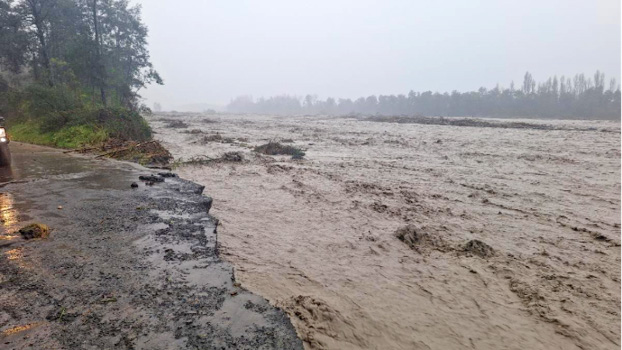
Floodwaters damaged roads and riverbanks across Kaikōura
What we're working on
Stopbank repairs - Kōwhai River
Great progress has been made across the stopbank breach sites following the July flood event.
All six priority stopbank sites have now been rebuilt to the required height, restoring flood protection along these sections of the Kōwhai River.
Rock armouring has been completed at four sites, with work on the two remaining sites starting late next week. Rock is being recovered from the Kōwhai River and used to armour the repaired stopbanks. A total of 35,000t has so far been recovered (around 1400 truck loads).
Kōwhai River high-flow channels
High-flow channels are being cut in sections of the Kōwhai River to help re-establish flow paths through areas of the river that have changed following the flood.
This gives floodwaters an additional pathway to move through during high flows, helping to ease pressure on the surrounding banks and protect the repaired stopbanks further downstream.
These works are generally undertaken with a 30t Excavator and large bulldozer to reprofile the bed.
Other recovery work includes:
- Harnetts Creek – Channel works have been completed to remove gravel build-up, ease hard corners and clear snags.
- Red Swamp Road – Blocked drains are being cleared to improve drainage through the system.
- Stoney Creek – Work is ongoing at several locations along Stoney Creek where the riverbed has built-up on the inside of bends. This has pushed the channel towards the opposite bank and caused erosion. A bulldozer is being used to redistribute gravel through the active channel.
- Swan Creek – At Swan Creek, work is underway to reinstate the damaged bank, with the area being rebattered and rock placed along the creek's edge to provide additional protection.
- Waimangarara River – Rock placement works have been undertaken to strengthen eroding banks. Further channel works to realign the river are starting soon.
We are working through the next critical areas of damage identified across the scheme and developing plans to repair these sites.
Gravel extraction
Significant gravel movement occurred during the July flood event, with large volumes of gravel and sediment deposited throughout the Kowhai River and Mt Fyffe stream systems.
We have cleared out the gravel traps on the Mt Fyffe stream system since the flood (these were empty prior to the flood too). We are waiting on full results of LiDAR surveys to help identify priority areas for future gravel management and channel maintenance.
While we are still waiting for the full LiDAR results to arrive, we have worked with the raw data and confirmed that while the riverbed has aggraded (built up) significantly in the Lower Kōwhai gorge, the amount of change in the lower river where the stopbanks are located is far less than we initially estimated.
Flood recovery gravel extraction
A streamlined process to enable gravel extraction for eligible flood recovery work has been extended to 30 October 2026. This provides a fast, free method for contractors and land owners to obtain permission to extract gravel in response to the flood event.
Common questions about flood recovery
Find answers to common questions about the Kaikōura flood and recovery. We'll continue to add and update information as it becomes available.
How significant was the recent flooding in Kaikōura
The July 2026 Kaikōura flood was a significant event. Early analysis indicates rainfall was 25–50% greater than during the 1993 flood and may have exceeded what is typically considered a 1-in-100-year rainfall event in some locations.
The flood caused significant erosion, transported large volumes of gravel and sediment through river systems, and damaged flood protection assets across the district.
While there was damage and disruption, early observations indicate that decades of investment in flood protection, river management and monitoring systems helped reduce impacts to the community. Detailed assessments are continuing as recovery work gets underway.
What is Environment Canterbury's role in flood protection and recovery?
We work with communities to manage flood and erosion risks.
We manage 59 river and drainage schemes across Waitaha Canterbury. These schemes include stopbanks, drains, erosion protection works and other infrastructure designed to reduce flood and erosion risk.
Most of our flood protection work happens when the weather is calm. We spend the year maintaining flood protection infrastructure on the schemes we manage, monitoring river systems and planning improvements to help reduce flood risk and build resilience.
We also monitor river flow and rainfall conditions.
After an event like this, we assess damage, prioritise repairs, support recovery planning and funding discussions, repair flood protection assets and undertake river management activities, including enabling gravel extraction where appropriate.
Find out more about Flood protection and community resilience.
What are you doing about the gravel in the river?
Gravel extraction is a key part of the recovery effort. We've put in place a streamlined process to enable gravel extraction for eligible flood recovery works, helping communities, the local council, landowners and contractors respond quickly where gravel is needed for repairs.
Request flood recovery gravel authorisation
Information about the flood recovery gravel authorisation is available, and our staff are working directly with people who need support to access it.
Why is there so much gravel in the river network?
The recent flood moved huge amounts of gravel and sediment through Kaikōura's rivers. In some places, river channels changed and gravel built up in new locations.
In the wake of the 2016 Kaikoura earthquake, hundreds of landslide dams came down across the region. These landslides are located high in the headwater gorges of the rivers and are virtually inaccessible for direct gravel extraction.
Many of these landslides have cleared or reduced over time but in this latest event, the remaining landslide debris in these valleys was washed into the riverbed and moved downstream in huge volumes which contributed to the impact of the flooding.
Some of these landslides remain, and we know the lower parts of these catchments will receive massive amounts of gravel in the future. We are carrying out detailed surveys, including LiDAR flights, to understand where gravel has accumulated and how river channels have changed. Information gathered through surveys and assessments will help identify where gravel management may be needed to support recovery, restore river capacity, and reduce future flood risk.
Gravel extraction will play an important role in recovery. Extraction is demand driven, commercial operators remove it from the river and transport it to places it can be used for roads and other infrastructure. Under a usual model, the amount of gravel taken in any one year depends on how much is needed by the building sector.
We've put in place a streamlined process for eligible flood recovery works to help communities, councils, landowners and contractors access gravel more quickly for repairs.
What is the timeline for repairs?
Recovery from a flood of this scale will take time. Some urgent repairs can be completed quickly, while larger projects may take several years to plan, fund and deliver.
Our immediate focus is assessing damage, prioritising the highest-risk sites and identifying the work needed to restore and strengthen flood protection assets. Recovery work will be staged and some activities can only be completed during suitable seasonal conditions.
We will continue to provide updates as assessments are completed and work programmes are confirmed.
How can Environment Canterbury help landowners/farmers?
We are very mindful of the pressure some in our community are under, and we are keeping in close contact with all agencies involved in the recovery to best support everyone in our communities.
The Rural Support Trust is the lead agency supporting households under pressure, and we will continue to work closely with them throughout the recovery.
When we are aware that a household is affected by pressures such as flooding, health or mental wellbeing, we have a range of options to alter our regulatory approach.
Find out more about what support is available for farmers to help respond to the region's flood
How much is this going to cost and how is it funded?
Assessments are ongoing, but current estimates put damage to Kaikōura's flood protection assets at around $20 million. We expect this figure to increase significantly as we continue to understand the full extent of the damage.
Detailed surveys, including LiDAR flights, are underway to assess how river channels have changed, where gravel and sediment have accumulated, and what recovery work is required.
We will be engaging with NEMA regarding potential recovery funding. We'll also work through the normal funding processes as we develop a longer-term recovery programme. At this stage, it is too early to confirm how costs will ultimately be shared or funded.
Looking for other recovery information?
If you're looking for information about emergency assistance, welfare support, road closures, damaged infrastructure, or recovery services, visit: