
Make a splash – check the water quality grades for this summer
As temperatures climb, Waitaha Canterbury offers plenty of scenic beaches, lakes and rivers for a summer swim. At the start of each season, we publish long-term water quality grades for popular swimming sites, based on sampling results from the past five summers.
Latest results heading into the 2026-27 season
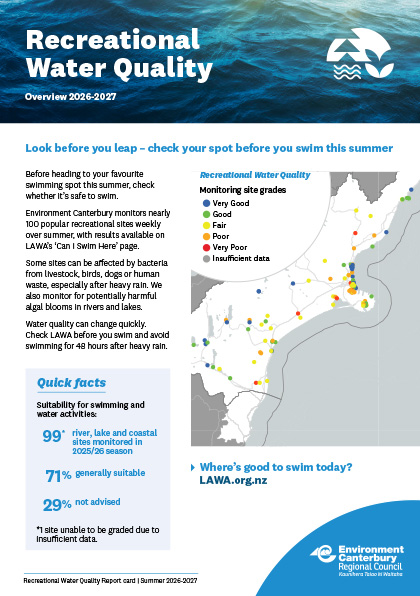
This year, 71% of Canterbury’s monitored swimming sites are suitable for contact recreation, including swimming and other water-based activities.
Water and Land Manager Dr Elaine Moriarty said Environment Canterbury monitors 52 popular freshwater sites and 47 coastal sites each summer, starting in mid-November.
"Our teams collect water samples each week and test for faecal indicator bacteria, helping people make informed choices about where to swim," she said.
Positive results at open coastal sites
- 95% of Canterbury’s open coastal beach sites were graded suitable for contact recreation.
- This maintains the same high standard as the 2025–26 season.
"Canterbury’s beaches continue to perform exceptionally well, which is fantastic news for beachgoers," Dr Moriarty said
Mixed results for freshwater sites
- 71% of freshwater sites are suitable for recreation.
- Lake sites performed well, with 88% suitable.
- River sites showed more variability, especially in urban and agricultural areas.
Examples of suitable sites:
- Rakaia River at Gorge
- Ōpihi River at SH79/Fairlie
- Hakataramea River at SH82
- Ashley River/Rakahuri above Rangiora-Loburn Bridge
Examples of unsuitable sites this season
- Hurunui River at SH7
- Selwyn River/Waikirikiri at Upper Huts
- Ashburton River/Hakatere at SH1
- Temuka River/Te Umu Kaha at SH1
"We will continue to work with local councils and the community to identify the sources of the contamination and improve water quality at these popular recreational sites," said Dr Moriarty.
More sites, smarter swimming advice: harbour predictive model expands for 2026/27
Following a successful first season, Environment Canterbury’s predictive water quality model returns this summer with timely swimming advice for more sites in Whakaraupō Lyttelton and Akaroa Harbours.
Cass Bay (main beach) and Governors Bay (Sandy Beach) have joined the model this season, bringing the total number of covered sites to 15.
Using 13 years of monitoring data alongside current weather and tidal conditions, the model generates hourly predictions of swimming suitability at these popular harbour sites.
“Before the model was introduced, several harbour sites could carry season-long health warnings and be considered unsuitable for swimming throughout summer,” Dr Moriarty said.
“We know that was frustrating. The model now gives more swimmers timely, condition-based advice to help them decide when and where to take the plunge.”
Long-term grades and current conditions
This is particularly important following sewage overflows and discharges that affected water quality in Whakaraupō Lyttelton Harbour and Akaroa Harbour last summer, contributing to unsuitable long-term grades at several sites this season.
While these grades reflect longer-term water quality, they don’t necessarily reflect conditions on any given day.
Using the predictive model, swimmers can see a more up-to-date picture of current water quality based on hourly predictions for all 15 monitored harbour sites. This includes:
- Charteris Bay/Te Wharau at Paradise Beach
- Akaroa main beach
- Duvauchelle Bay and Tikao Bay/Ōkoropeke
- as well as the newly added Cass Bay (main beach)
- Governors Bay (Sandy Beach).
Check water quality before you swim
Long-term grades summarise the past five years and are updated after each season. Weekly sampling gives a more current picture of water quality as conditions change.
"Canterbury has fantastic places to cool off, and it’s great that 70% of monitored sites remain suitable for contact recreation this summer," Dr Moriarty said.
Top tips for safer swimming:
- Check LAWA first – get the latest water quality updates.
- Wait 48 hours after rain – runoff can carry bacteria into waterways.
- Toe test – if you can’t see your toes standing knee-deep, don’t swim.
Stay safe this summer: Visit the LAWA’s Can I Swim Here? website to check current water quality before jumping in.
Public health warnings
During the 2025/26 summer 30 temporary warnings were issued across 27 sites:
- 13 for faecal contamination
- 17 for toxic algae
"Temporary warnings help keep people informed when conditions change," Dr Moriarty said.
River, marine and lake health warnings: Check our health warnings webpages to see sites with current alerts.
El Niño summer: know before you go
The forecast Super El Niño could bring drier, windier conditions in eastern areas and heavier rain and flooding in alpine-fed rivers. Extended dry spells may also lead to lower flows and warmer water – conditions that can encourage toxic algae growth.
"Conditions can shift throughout the season – and even from one day to the next – so before diving in, look for any flood warnings on our website and the check water quality at the LAWA Can I swim here? page," Dr Moriarty said.
Toxic algae, also known as cyanobacteria, occurs naturally in Canterbury waterways but can flourish in warm, slow-moving water. Blooms can produce toxins that are harmful to people and potentially fatal to dogs.
Even a small amount – about the size of a 50-cent piece – can pose a health risk if swallowed. Toxic algae can also appear outside monitored sites, so learn what to look for to help keep your whānau and pets safe.