
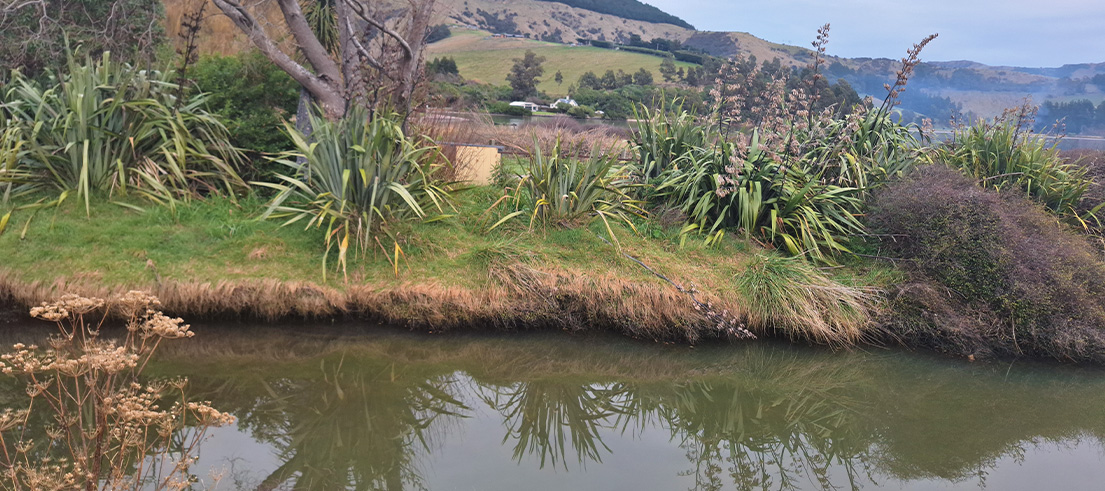
Te Wharau Stream's native fish survive major flood
After heavy rainfall left parts of Banks Peninsula badly flooded in February, biodiversity experts feared the worst for native critters and fish in Te Wharau Stream, which flows through Te Ahu Pātiki and Orton Bradley Park.
On 20 January, shortly before the flood, Banks Peninsula Conservation Trust staff tested environmental DNA (eDNA), genetic material shed by organisms into their surroundings, at two locations along the stream and found a wide range of fish, invertebrates and birds in and around it.
The flooding event on 16 February created slips, gouged out the stream banks and washed a huge amount of debris downstream. Locals and ecologists thought that a lot of the species recently found living in the stream would be dead or washed away.
When eDNA was tested again at the same two sites after the flood on 19 March, the findings showed that, against all odds, a number of the stream's precious residents likely survived, swam upstream or were able to find refuge during the flood event. Whaka-Ora Healthy Harbour programme manager Sarah Wilson said, “beyond all our wildest dreams, many critters survived the deluge.”
What the eDNA revealed
Across the two rounds of eDNA testing, nine species of native fish were detected before the flood, and eight were detected after it.
Environment Canterbury biodiversity advisor Martin Rutledge said, “the latest eDNA analysis shows, while some macroinvertebrate species are absent post-flood, there is still a good diversity of macroinvertebrate species such as mayfly and caddisfly, which are basic food for the no doubt hungry native fish.”
“The range of macroinvertebrate species found post-flood also reflects good water quality – a positive sign given the horrendous amount of sediment that washed down the stream in the flood.”
Mystery crab DNA raises questions
The most curious discovery after the flood was eDNA of a hairy-handed crab (Hemigrapsus crenulatus) detected well upstream. As the species is not adapted to freshwater, its presence in the stream is a mystery.
Martin said his guess is the crab could have been caught by a bird such as a kotare, which may have dropped some of its remains in the water.
“This crab finding illustrates the need for caution in interpreting eDNA results, but I find it fun speculating on the potential origin of the detected eDNA.”
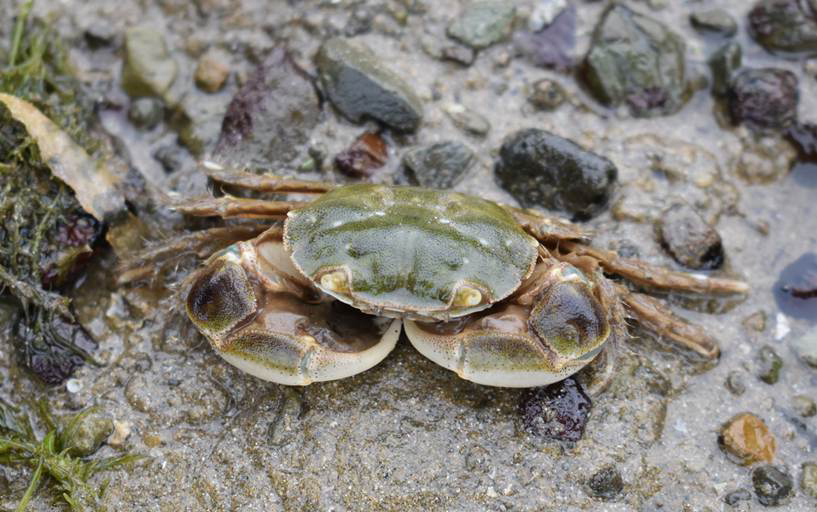
Hairy-handed crab (Hemigrapsus crenulatus)
Restoring Te Wharau catchment ki uta ki tai
The Whaka-Ora Healthy Harbour programme recently approved $46,000 of funding for a Te Wharau fish passage project which will remove a collapsed ford and replace it with a pre-fabricated slab bridge, allowing free and easy access for fish through the stream.
Environment Canterbury staff and volunteers will help Orton Bradley Park manage the safe catch and release of fish in the stream while the work is undertaken.
Co-governors have also approved a $115,000 three-year project with Orton Bradley Park and landowners to convert what is currently a bull paddock near the Orton Bradley Park entrance into a coastal wetland.
Whaka-Ora partners Christchurch City Council and Ngāti Wheke will both play a key role in this project, with Ngāti Wheke having engaged their field-work crew, Tiaki Taiao, who have already begun planting this winter.
Sarah says these projects are significant for the Te Wharau catchment.
“The ford improvements and especially the construction of the wetland will complete the ki uta ki tai vision for the catchment, connecting the flow of wai from the mountains to the sea. This is great news for our native fish and all sorts of other critters that we want to see thriving.”
Learn how the Whaka-Ora Healthy Harbour programme is restoring waterways, wetlands and biodiversity across Whakaraupō Lyttelton Harbour.
Related resources
- Orton Bradley Park – Walking tracks, native bush, heritage, recreation and conservation in Charteris Bay
- Whaka-Ora Healthy Harbour – Discover the long-term partnership restoring the ecological and cultural health of Whakaraupō/Lyttelton Harbour.
- Rāpaki Rūnanga – Official website of Te Hapū o Ngāti Wheke (Rāpaki), with information about the marae, iwi, history and environmental work