
Encourage learners to explore the relationships between people, places, plants, animals, and waterways. Learners can investigate what makes their local environment unique, consider the mauri of a place, and develop an understanding of how everything is connected through whakapapa.
Biodiversity and pest education resource kete
Through whakapapa, all living things are connected, and every plant and animal has its own mana, or special value and importance. The health of our rivers, forests, wetlands, grasslands, and coastlines is closely connected to the wellbeing of our communities.
In Waitaha Canterbury, some native plants and animals need our help because their habitats are changing, and some introduced species can make it harder for them to thrive. While all species have their own place and value, some can affect the balance of local ecosystems. By learning about these challenges and working together, we can help protect native biodiversity and care for the places we all share.
Some introduced plants and animals can have significant impacts on native biodiversity, ecosystem health, cultural values, and productive land use. Where these impacts occur, they may be managed as pests.
This education resource kete is aimed at year 5-8 learners, but it can be easily adapted to suit other ages.
Our approach to pest management
Canterbury Regional Council (Environment Canterbury) provides regional leadership in pest management in Waitaha Canterbury through our biosecurity programme.
Our approach to pest management is guided by the Canterbury Regional Pest Management Plan 2018-2038 which outlines the regulatory requirements for priority pests across the region, and the Biosecurity Act 1993.
We are proud to partner with Toimata Foundation to offer the Enviroschools Programme to Waitaha schools.
Enviroschools is an environmental, action-based programme where young people are empowered to design and lead sustainability projects in their schools and early learning centres, communities, and beyond.
Activities and resources
Our biodiversity and pest education resources are organised around the Enviroschools Action Learning Cycle (ALC). The ALC is central to the Enviroschools approach to inquiry-based, action learning and is a key tool for guiding specific projects or units of learning.
Some of our activities and planning templates have been adapted with permission from Enviroschools resources.
We recommend following the ALC, beginning with identifying the current situation, and placing emphasis on taking action to bring about meaningful change in our fight against invasive pests in Waitaha Canterbury.
This ‘resource bank’ is designed for you to use what is most relevant to support biodiversity and pest education in schools by providing activities and resources that can be adapted to suit your ākonga (learners') learning intentions.
The activities in Identify the Current Situation are aimed at upper primary and intermediate students but can be adapted by kaiako (teachers) to suit other year levels.
As learners move through the Action Learning Cycle, they will investigate the current biodiversity and pest situation, explore alternatives, take action, and reflect on change.
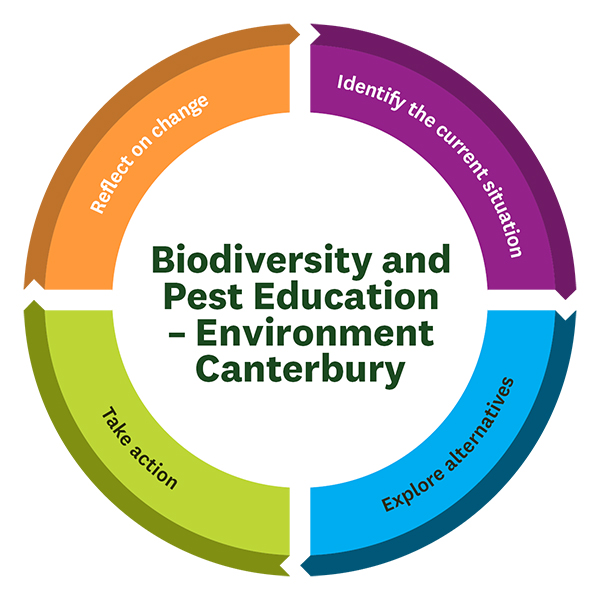
The Enviroschools Action Learning Cycle
Field trips
The 4-step path to success
Discover our activities and resources which are organised into each stage of the Action Learning Cycle. Begin with 'Identify the current situation'.
Whakapapa, mauri, and understanding place
Mātauranga Māori, collective knowledge, and innovation
Invite learners to explore a variety of approaches to biodiversity protection and restoration, drawing on scientific knowledge, local experience, community initiatives, and mātauranga Māori. This stage provides opportunities to consider different perspectives and imagine positive futures for local ecosystems.
Kaitiakitanga, manaakitanga, and collective responsibility
Support learners to take action that demonstrates care for people, place, and biodiversity. This may involve working collaboratively, building partnerships, contributing to community wellbeing, and recognising the shared responsibility we all have in supporting healthy ecosystems.
Mauri, stewardship, and intergenerational wellbeing
Encourage learners to reflect on the difference their actions have made for the environment, their community, and themselves. Learners can consider how their work has contributed to the health and wellbeing of local ecosystems and what ongoing stewardship may look like for future generations.
If you can’t see what you are after, or if you have any questions, please email our team.